Choosing the right Laboratory Information Management System (LIMS) is one of the most important technology decisions a construction materials testing (CMT) or geotechnical lab will make.
Unlike generic laboratory software used in pharmaceutical or clinical environments, LIMS platforms for construction materials testing labs must support complex field-to-lab workflows, standards-based testing procedures, and strict compliance requirements such as ASTM, AASHTO, and ISO 17025.
The right LIMS can help labs:
- Streamline sample tracking and test workflows
- Reduce manual data entry and transcription errors
- Pass audits with confidence
- Improve turnaround times for reports and certifications
- Scale operations without adding administrative overhead
The wrong system often results in expensive customizations, frustrated technicians, stalled adoption, and continued reliance on spreadsheets.
Whether you are upgrading from Excel or replacing a legacy platform, this guide will help you:
- Compare LIMS software for geotechnical and construction materials testing labs
- Understand which features truly matter
- Identify red flags before committing to a vendor
👉 If you are earlier in your evaluation process, start with our full overview of the best LIMS for geotechnical and construction materials testing labs.
What Is a LIMS for Construction Materials Testing?
A Laboratory Information Management System (LIMS) for construction materials testing is software designed to manage the full lifecycle of testing workflows used by geotechnical and CMT laboratories.
Unlike generic laboratory software used in pharmaceutical or clinical labs, a construction materials testing LIMS must support standards such as ASTM, AASHTO, and ISO 17025 while connecting field sampling, laboratory analysis, and final reporting.
A LIMS for geotechnical and materials testing labs typically helps teams:
- Track samples from field collection through laboratory testing
- Automate calculations for ASTM and AASHTO test methods
- Maintain full chain-of-custody documentation
- Generate compliant reports and certifications
- Prepare documentation for accreditation audits
Because construction materials testing involves both field inspections and laboratory workflows, modern LIMS platforms also integrate mobile data capture and real-time project visibility.
Why LIMS Software Is Critical for CMT & Geotechnical Labs
Construction materials testing labs manage complex workflows that combine field sampling, laboratory analysis, reporting, and regulatory compliance.
Without a purpose-built LIMS, labs often rely on disconnected tools such as:
- Excel spreadsheets
- Paper field forms
- Shared network drives
- Manual reporting templates
These manual processes create several operational risks:
- Lost or inconsistent sample records
- Calculation errors during testing
- Slow report turnaround times
- Difficult audit preparation
- Poor coordination between field technicians and lab teams
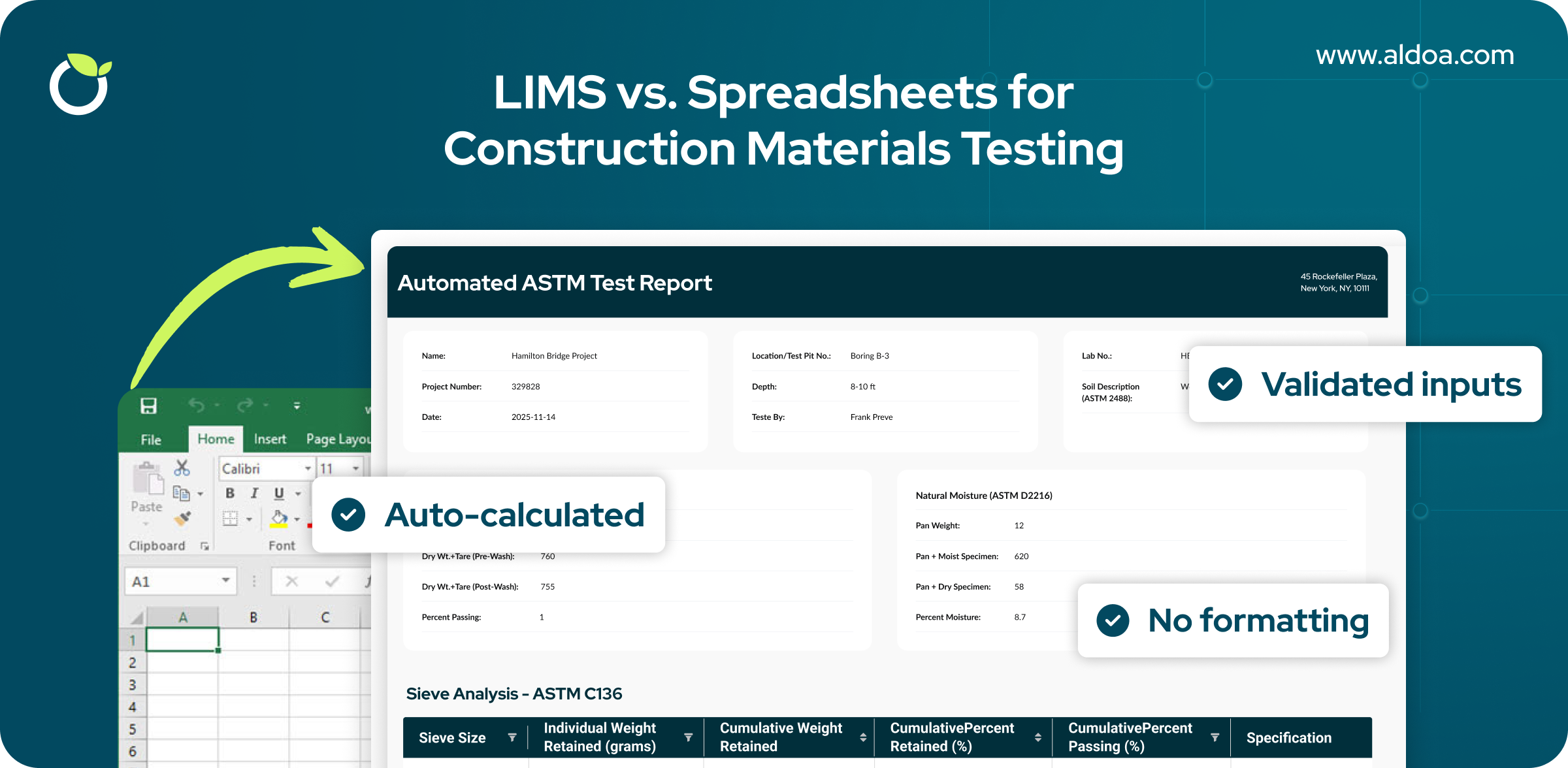
A modern construction materials testing LIMS solves these problems by centralizing all workflows into a single system.
Core Features Every CMT or Geotechnical Lab Needs
A LIMS for CMT and geotechnical labs must support standards-based workflows, field data capture, and traceable reporting. Below are the key capabilities to evaluate.
1. Standards-Based Workflows (ASTM, AASHTO, ISO 17025)
Construction materials testing labs operate under strict regulatory and accreditation requirements.
A modern LIMS should support:
- Preloaded test templates for ASTM and AASHTO procedures
- Built-in validation logic for calculations and tolerances
- Automated compliance checks for reporting
- ISO 17025-compliant documentation and audit trails
Without these capabilities, labs often rely on manual spreadsheets or custom scripts to verify results.
👉 For a deeper look at how digital systems support regulatory requirements, see our guide to ASTM and AASHTO compliance in a LIMS.
2. Full Sample Lifecycle Tracking
Construction testing labs process thousands of samples each year. A capable LIMS should track each sample from collection to final report.
Key capabilities include:
- Unique sample IDs or barcodes
- Tracking from field collection to lab testing and report delivery
- Linked metadata such as:
- Photos
- GPS coordinates
- Sample depth
- Field technician notes
This ensures complete traceability, which is essential during audits, disputes, and project documentation reviews.
3. Chain of Custody and Traceability
In regulated testing environments, every action must be traceable.
A LIMS should provide:
- Timestamped actions and digital signatures
- Role-based permissions and approvals
- Complete audit trails of edits and data access
Without these features, labs often spend days manually preparing documentation for AASHTO re:source or ISO audits.
4. Equipment Calibration Management
Equipment calibration is one of the most common compliance issues for labs using spreadsheets or disconnected systems.
A LIMS should help labs:
- Automatically schedule calibration events
- Store calibration certificates and records
- Prevent testing with uncalibrated equipment
- Track maintenance history for devices
These tools help labs stay compliant with ASTM and ISO accreditation requirements.
5. Field-to-Lab Integration
Construction materials testing workflows often begin in the field.
Field technicians may collect:
- Concrete cylinders
- Soil samples
- Asphalt cores
- Aggregate materials
When field data is captured on paper or separate mobile tools, labs must manually re-enter the information, creating delays and errors.
A modern LIMS should provide:
- Mobile-friendly access for field technicians
- Seamless handoff from field data collection to lab workflows
- Real-time visibility into sample status
👉 This is one of the primary reasons labs move away from spreadsheets. Learn more in our breakdown of LIMS vs spreadsheets for materials testing labs.
6. Automated Reporting and Client Delivery
Reporting should never require copy-and-paste workflows.
A purpose-built LIMS should support:
- Configurable report templates for different test types
- Automatic generation of reports and certifications
- Built-in calculations for test results
- Secure delivery through client portals or automated email
Automated reporting helps labs reduce turnaround times and improve client satisfaction.
Questions to Ask LIMS Vendors Before You Buy
Selecting a LIMS for construction materials testing labs is a long-term investment. Vendors often highlight marketing features but avoid implementation details.
Ask questions that reveal how the system actually performs.
Examples include:
- Is your software purpose-built for construction materials testing labs?
- Which ASTM, AASHTO, and ISO templates are included out of the box?
- Can the system manage field-to-lab workflows without manual steps?
- What does onboarding and technician training look like?
- How do you support data migration from spreadsheets or legacy systems?
- Is your platform cloud-based, on-premise, or hybrid?
- How frequently are updates released?
LIMS Comparison Table for Construction Materials Testing Labs
This comparison reflects Aldoa’s perspective based on publicly available product information and conversations with CMT and geotechnical firms evaluating LIMS platforms.
| Feature / Capability |
Aldoa LIMS |
Generic LIMS Vendors |
Other CMT-Specific LIMS |
| Built for CMT & Geotechnical Labs |
✅ Purpose-built |
❌ Pharma/clinical focus |
✅ Yes |
| ASTM & AASHTO Test Templates |
✅ Preloaded |
❌ Custom setup required |
✅ Included |
| Field-to-Lab Workflow Integration |
✅ Mobile ready |
❌ Not designed for field |
✅ Included |
| Sample Chain of Custody |
✅ End-to-end traceability |
⚠️ Manual add-ons |
✅ Included |
| Automated Report Generation |
✅ Built-in templates |
❌ Requires configuration |
✅ Included |
| Cloud-Based Access |
✅ Modern cloud platform |
⚠️ Often on-prem |
✅ Cloud |
| Onboarding Support |
✅ Hands-on migration support |
❌ Self-service |
⚠️ Varies |
| Technician-Friendly Interface |
✅ Simple UI |
❌ Complex interfaces |
⚠️ Varies |
| Audit Preparation |
✅ One-click reports |
❌ Manual documentation |
⚠️ Varies |
Red Flags to Watch For
When evaluating LIMS software for construction materials testing labs, watch for warning signs.
🚩 One-Size-Fits-All Platforms: Generic LIMS systems built for biotech or clinical labs rarely support ASTM workflows.
🚩 Limited Standards Support: Manually creating ASTM or AASHTO templates is time-consuming and risky.
🚩 No Field Integration: Disconnected field workflows lead to duplicate data entry and delays.
🚩 Manual Reporting Processes: If reports require Excel or Word editing, the system is not fully automated.
🚩 Overly Complex Interfaces: If technicians require months of training, adoption will struggle.
🚩 Weak Support During Implementation: Successful LIMS deployments require onboarding support and workflow guidance.
What Successful Labs Look for in a LIMS
Labs that successfully implement LIMS platforms tend to:
- Start with high-impact workflows such as concrete strength testing or soil compaction
- Invest in technician training
- Choose vendors with deep knowledge of ASTM, AASHTO, and ISO standards
- Focus on systems that connect field, lab, and reporting workflows
Many CMT firms also use LIMS as a competitive advantage by offering:
- Faster turnaround times
- Digital client reporting portals
- Transparent documentation for audits
Conclusion: The Right LIMS Is a Strategic Advantage
Selecting the right LIMS for construction materials testing and geotechnical labs is not just a software purchase. It is a long-term operational decision.
A purpose-built LIMS helps labs:
- Stay compliant with ASTM, AASHTO, and ISO standards
- Eliminate spreadsheet errors and manual workflows
- Deliver faster and more reliable reports
- Remain audit-ready at all times
Labs that modernize their workflows often see immediate gains in efficiency, accuracy, and client satisfaction.
👉 To see how a purpose-built system works in real-world CMT workflows, start with our guide to the best LIMS for geotechnical and construction materials testing labs, or schedule a demo of Aldoa.
.svg "Aldoa Assets (3)")