What Is ASTM D1557 (Modified Proctor Test)?
ASTM D1557, also known as the Modified Proctor test, determines the maximum dry density (MDD) and optimum moisture content (OMC) of soils using a higher compactive effort than ASTM D698. The test uses:
- A 10 lb hammer
- Dropped from an 18 in height
- 25 blows per layer
- Typically 3 layers per mold
The resulting moisture–density curve becomes the reference for all field density tests on the project. Accuracy is critical, because incorrect MDD or OMC values can lead to poor compaction, settlement, rutting, and expensive rework.
This guide explains what ASTM D1557 measures, how Modified Proctor tests are performed, common workflow challenges labs face, and how modern digital systems simplify compaction testing, curve generation, and reporting.
Who This Guide Is For
This guide is written for construction materials testing (CMT) labs, geotechnical engineering teams, and DOT-focused firms that run ASTM D1557 (Modified Proctor) tests at scale and need accurate, defensible results with faster turnaround.
Why ASTM D1557 Matters
Geotechnical and CMT teams perform Modified Proctor tests daily. Any inefficiency in the workflow slows down:
- Field compaction tests
- Approval timelines
- Report turnaround
- Client communication
When Modified Proctor workflows are inefficient or inconsistent, the impact extends beyond the lab. Field compaction tests slow down, approvals are delayed, and reporting backlogs frustrate contractors and owners.
ASTM D1557 vs ASTM D698 (Modified vs Standard Proctor)
| Feature |
ASTM D1557 (Modified) |
ASTM D698 (Standard) |
| Hammer Weight |
10 lb |
5.5 lb |
| Drop Height |
18 in |
12 in |
| Compactive Effort |
≈56,000 ft-lb/ft³ |
≈12,000 ft-lb/ft³ |
| Use Case |
Roadways, structural fill, heavy loads |
Light foundations, small structures |
Moisture content values used in Modified Proctor testing are commonly determined using ASTM D2216 Moisture Content, which plays a critical role in accurate dry density calculations.
Because Modified Proctor uses a much higher compactive effort, its results are often required for pavement subgrades, building pads, and general site development.
ASTM D1557 Test Procedure (Step-by-Step Summary)
1. Prepare the Soil Sample
- Air-dry or oven-dry per ASTM requirements
- Break down aggregations without altering particle sizes
- Determine mold size and mold constant
2. Compact Soil in the Mold
- Place soil in three layers
- Apply 25 blows per layer with a 10 lb hammer
- Record wet weights, moisture content, and observations
3. Calculate Moisture and Dry Density
For each trial point:
- Measure wet mass
- Determine water content
- Compute dry density
4. Identify MDD and OMC
Plot:
- Moisture–density curve
- Zero Air Voids curve (optional)
Peak of the curve → Maximum Dry Density
Corresponding moisture → Optimum Moisture Content
Why Traditional Compaction Workflows Are Inefficient
While ASTM D1557 defines the technical procedure clearly, many labs struggle with the operational side of running Modified Proctor tests at scale. Most labs still rely on spreadsheets, handwritten notes, or Word templates to perform calculations and generate reports. This leads to several well known issues:
Manual transcription errors
Handwritten moisture readings, weight measurements, or blow counts get copied incorrectly. Even a small error can produce a misleading MDD or OMC value that cascades across field testing reports.
Non standard worksheets
Each technician may use a different worksheet format or spreadsheet version. This makes training inconsistent and introduces risks during audits or DOT reviews.
Slow communication between field and lab
Field teams often hand off sample IDs on paper or through text messages. Lab technicians may receive incomplete information or may not know which field assignment the sample belongs to.
Curve fitting inconsistencies
Moisture density curves require careful plotting. Spreadsheet based curve fitting often depends on a technician's judgment or formula accuracy. Different people produce different results.
Reporting delays
Compaction test reports may take days due to manual formatting, copying values between systems, or waiting for approvals.
These challenges become more severe as testing volume increases, especially for labs operating without a centralized lab management system. Aldoa addresses this by unifying field data, lab calculations, curve generation, and reporting in a single platform.
See a Digital ASTM D1557 Workflow: Learn how labs run Modified Proctor tests without spreadsheets, manual curve fitting, or report delays. See how Aldoa runs D1557.
A Modern ASTM D1557 Workflow Using Aldoa
Aldoa provides a unified field–lab workflow built specifically for geotechnical and CMT teams. It eliminates spreadsheets, manual curve fitting, and disjointed communication.
Step One: Field Sample Creation
Most compaction workflows begin in the field. Aldoa gives field technicians a streamlined interface to create a new sample directly inside the project record or boring log context. They can add:
- GPS location
- Depth or elevation
- Sample type
- Photos
- Any field observations (moisture, color, organics, inclusions, or structure)
-1-1.png?width=1930&height=1459&name=Group%2027378%20(1)-1-1.png)
The field technician assigns a unique barcode or sample ID. This ensures the lab knows exactly which project and location the sample comes from, avoiding any confusion later. Because the field and lab share the same system, the lab receives the sample instantly. There is no need for email, text messages, or printed tags.
Step Two: Lab Receives the Sample
Lab technicians view all incoming samples on a simple dashboard. Each item includes:
- Project details
- Sample description
- Field notes
- Photos
- Priority or required-by date
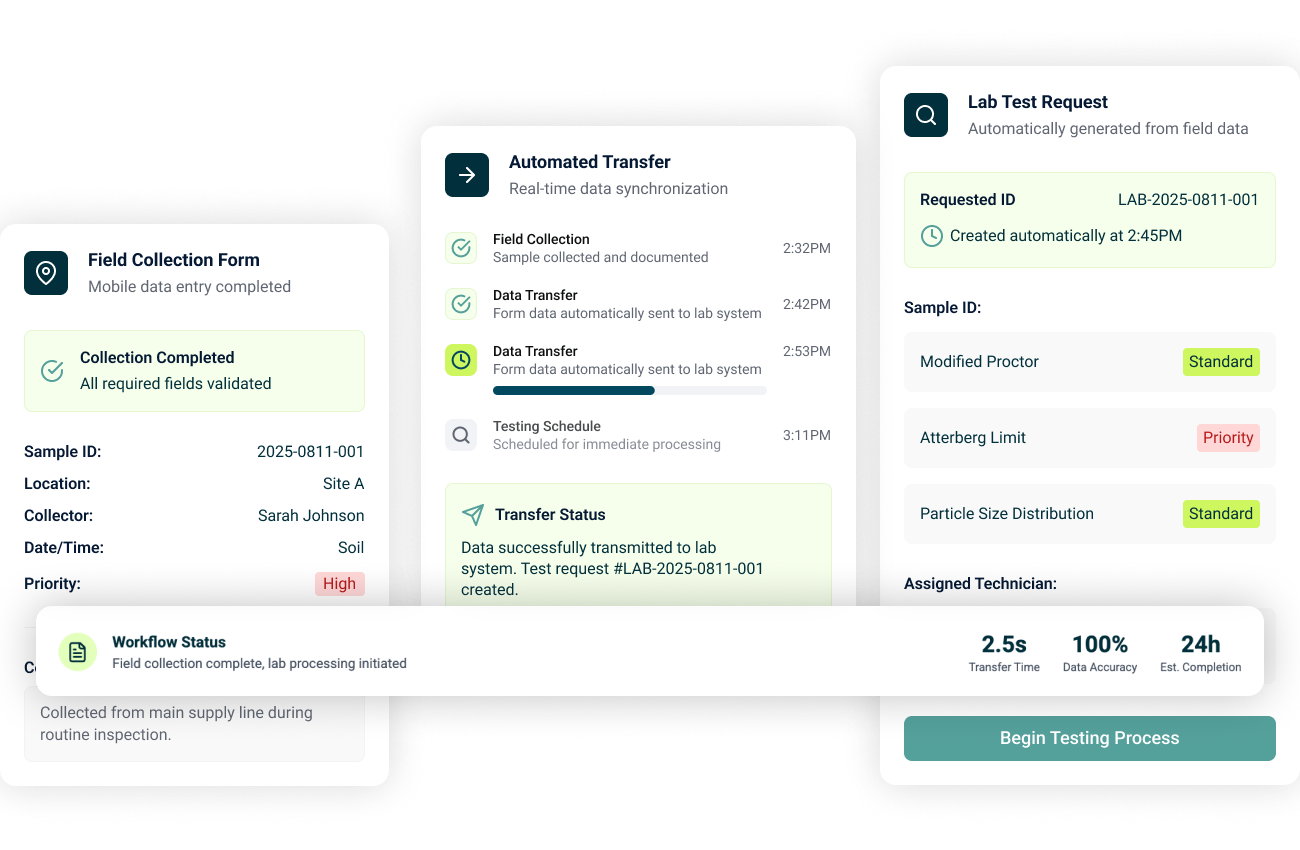
This eliminates guesswork and reduces the need for internal communication. It also gives lab supervisors visibility across workloads so they can plan testing schedules accurately.
Step Three: Digital ASTM D1557 Worksheet
Aldoa includes a standardized digital form that supports all requirements of ASTM D1557 and AASHTO T 180. Every technician uses the same structure, which ensures consistency across the organization.
The form captures:
- Mold size
- Mold constant
- Hammer details
- Number of layers
- Wet weight of soil plus mold
- Weight of compacted soil
- Water content measurements
- Trial moisture values
- Trial dry density values
All calculations update in real time. Technicians see dry density and moisture content values immediately, reducing rework and miscalculations. Aldoa also provides built in flags to catch out of range or suspicious values that might indicate errors or unusual soil behavior.
Step Four: Automatic Curve Generation
The moment the lab enters trial data, Aldoa generates:
- Moisture density curve
- Optimum moisture content
- Maximum dry density
- Zero air voids curve (optional)
- Graphical cross plots for review
Moisture–density curve and MDD/OMC generated automatically from trial data.
.png?width=1736&height=1248&name=2%20(1).png)
Aldoa uses consistent curve fitting logic that is applied uniformly across all projects. This eliminates the inconsistencies found in spreadsheet based methods. Technicians can adjust trial points or add additional points if required. The curve updates automatically with each entry.
Consistent curve generation ensures that Maximum Dry Density and Optimum Moisture Content values are reproducible, defensible, and suitable for DOT and third-party review.
Step Five: Integrated Review and Approval
Lab managers can review the test inside the same system. They can:
- View raw measurements
- Review calculations
- Inspect the moisture density curve
- Add comments
- Approve or request corrections
The review process becomes clean and traceable. Audit logs keep a record of every update. This is especially valuable for firms working with DOTs, municipalities, and large general contractors that expect complete traceability.
For DOT and municipal projects, reproducibility and traceability matter as much as accuracy. Consistent curve fitting, standardized worksheets, and audit logs help labs defend results during reviews and disputes.
Step Six: Automated Compaction Report
Once the curve is approved, Aldoa generates a professional PDF report ready for delivery. The report includes:
- Project information
- Sample description
- Table of all trial points
- Moisture density curve
- Maximum Dry Density
- Optimum Moisture Content
- Zero Air Voids Curve (if included)
- Technician and reviewer signatures
- Notes or comments
ASTM D1557 report with trial data, curve, MDD/OMC, and reviewer approval.
.png?width=1968&height=2284&name=Frame%201261152538%20(1).png)
Reports follow a consistent formatting style across all projects and clients. This helps firms present a more professional image and reduces confusion for contractors who review reports daily.
By automating technical report generation, labs reduce turnaround time while delivering consistent, professional compaction reports across projects.
Key Benefits of Running ASTM D1557 in Aldoa
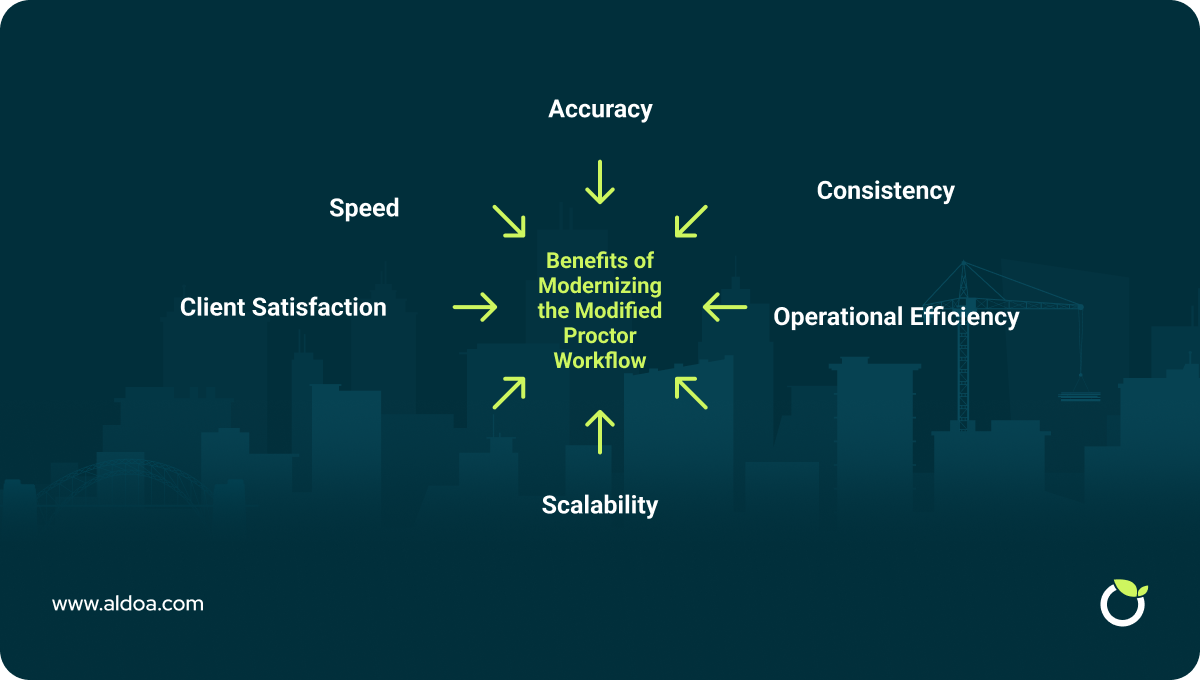
- Accuracy: Eliminates transcription and curve-fitting errors.
- Speed: Reports generate in minutes, not days.
- Consistency: Uniform worksheets, calculations, and reporting for every test.
- Client Satisfaction: Faster turnaround increases trust with contractors and DOTs.
- Scalability: Handle more testing volume without hiring more staff.
Related ASTM Testing Workflows
ASTM D1557 Modified Proctor testing is commonly performed alongside other soil classification and characterization standards, including:
Together, these standards provide the foundation for compaction control, soil classification, and geotechnical design.
FAQ: Common Questions About ASTM D1557
What is the difference between ASTM D1557 and ASTM D698?
ASTM D1557 uses a higher compactive effort and is required for heavier load applications. D698 is for lighter structures.
How many blows per layer in ASTM D1557?
25 blows per layer, typically over 3 layers.
When should I use Modified Proctor instead of Standard Proctor?
Use Modified Proctor when designing pavements, building pads, or any project with higher compaction requirements.
Does Aldoa support AASHTO T 180?
Yes — Aldoa’s digital workflow supports both ASTM D1557 and AASHTO T 180.
See How Aldoa Automates the ASTM D1557 Workflow
Get a compaction workflow demo: schedule a demo
Conclusion
The ASTM D1557 Modified Proctor test is essential for reliable compaction control, but traditional workflows make it slower and riskier than it needs to be. By unifying sample creation, calculations, curve generation, review, and reporting, Aldoa helps labs deliver accurate results faster and at scale.
.svg "Aldoa Assets (3)")