ASTM C136 (also written ASTM C136/C136M) is the standard test method for sieve analysis of fine and coarse aggregates. The procedure determines the particle-size distribution (gradation) of an aggregate sample by passing it through a stack of progressively finer sieves and weighing what is retained on each one. Results are reported as the percent retained, percent passing, and the fineness modulus — used directly in concrete and asphalt mix design.
However, traditional sieve analysis workflows are often slow and error-prone. Manual weighing, cumulative calculations, spreadsheets, and handwritten notes introduce inefficiencies and increase the risk of mistakes.
Aldoa eliminates this friction with a standardized ASTM C136 digital workflow that automates cumulative calculations, percent passing, and report generation. Whether performed in the lab or in the field, technicians complete tests faster, more consistently, and with fewer errors.
This guide explains what ASTM C136 measures, walks through the step-by-step procedure, highlights common testing challenges, and shows how Aldoa modernizes the entire process for CMT labs.

Key Takeaways
- ASTM C136 determines aggregate particle-size distribution for concrete and asphalt
- Manual sieve analysis is time-consuming and error-prone
- Aldoa automates calculations, validation, and ASTM-compliant reporting
- CMT labs can cut reporting time by over 80 percent
What Is ASTM C136?
ASTM C136 / C136M is the standard test method used to determine the particle-size distribution, or gradation, of aggregates. The test identifies the proportion of different particle sizes within a sample of fine or coarse aggregate.
In simple terms, it measures how much of a material consists of large stones, medium gravel, sand, and fine particles.
This test is critical for:
- Concrete and asphalt mix design to ensure proper workability and strength
- Base and sub-base construction to optimize compaction and drainage
- Quality control to maintain consistency across production batches
Results from ASTM C136 are typically compared against ASTM C33 (Standard Specification for Concrete Aggregates) or applicable state DOT specifications to verify compliance.
.png?width=2400&height=1176&name=ASTM%20C136%20%E2%80%93%20Sieve%20Analysis%20(1).png)
Why Sieve Analysis Matters for CMT Labs
Aggregate gradation influences nearly every property of construction materials:
- Concrete strength and durability depend on consistent particle distribution.
- Asphalt performance relies on a balance between coarse and fine materials for stability.
- Drainage and permeability are affected by the percentage of fine particles.
By understanding how aggregates are distributed, CMT labs can validate supplier quality, troubleshoot mix issues, and ensure every project meets design standards.
ASTM C136 Equipment Requirements
Aggregate Samples
- Representative test portion (fine or coarse)
- Oven-dried to constant mass
Required Equipment
- Balance accurate to 0.1 g or 0.1% of sample mass
- Standard sieve set (coarse + fine sizes)
- Mechanical shaker (recommended)
- Collection pan and cover
- Drying oven
Common sieve series include:
Coarse Aggregate: 5 in., 3½ in., 2 in., 1 in., ¾ in., ½ in., ⅜ in.
Fine Aggregate: No. 4 through No. 200
ASTM C136 Step-by-Step Procedure
The sieve analysis process separates aggregate particles by size, using a series of stacked sieves with progressively smaller openings.
1. Sample Preparation
- Dry the sample in an oven at 110 ± 5°C until it reaches constant weight.
- Record the total dry mass (Mₜ).
2. Sieve Selection and Setup
- Choose sieve sizes appropriate for the material type (coarse or fine).
- Stack sieves from largest opening at the top to smallest at the bottom.
- Place a pan under the last sieve to collect material passing through all openings.
3. Mechanical Shaking
- Place the dried sample on the top sieve.
- Secure the stack in a mechanical shaker and shake for a designated time (commonly 5–10 minutes) to achieve complete separation.
4. Weighing Retained Material
- Carefully remove each sieve and weigh the material retained.
- Record the mass retained on each sieve (Mᵢ).
5. Calculations
- Cumulative weight retained: Sum of weights retained on each sieve and all larger sieves above it.
- Percent retained: (Mᵢ / Mₜ) × 100
- Percent passing: 100 – cumulative percent retained
These values are typically displayed in a table format:
| Sieve Size |
Weight Retained (g) |
% Retained |
Cumulative % Retained |
% Passing |
| ¾ in. |
50 |
5 |
5 |
95 |
| ½ in. |
120 |
12 |
17 |
83 |
| ⅜ in. |
180 |
18 |
35 |
65 |
| No. 4 |
220 |
22 |
57 |
43 |
| No. 8 |
260 |
26 |
83 |
17 |
| Pan |
170 |
17 |
100 |
0 |
(Values shown for illustration only.)
6. Reporting
The final report includes:
- Identification of the sample
- Sieve sizes used
- Individual and cumulative weights retained
- Percentage retained and passing
- Graphical representation (gradation curve)
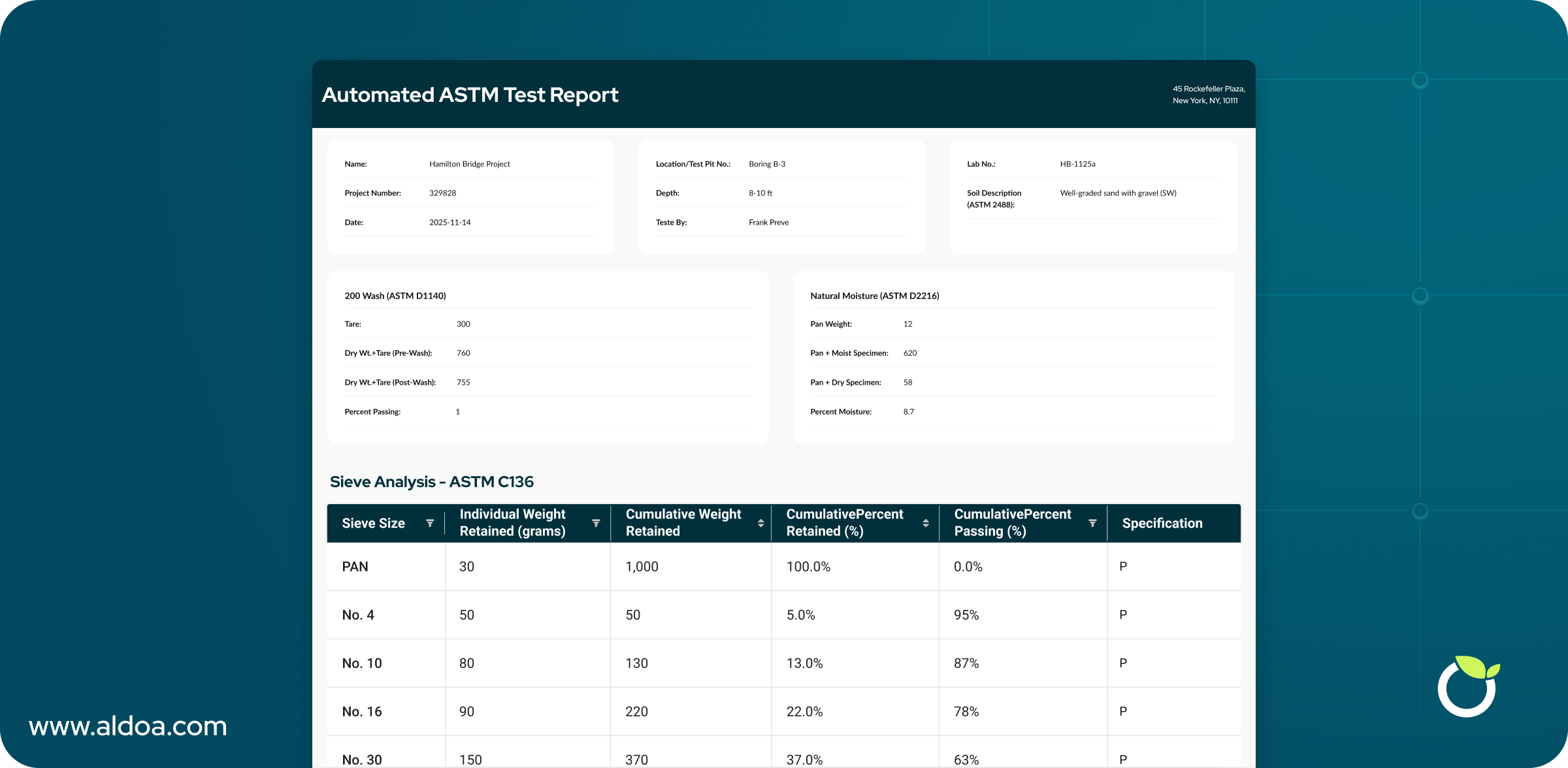
Interpreting ASTM C136 Results
The gradation curve plotted from the data helps visualize particle-size distribution.
- A well-graded aggregate has a smooth curve with a wide range of particle sizes, leading to dense, stable mixes.
- A poorly graded or uniform aggregate may cause segregation, higher voids, or reduced strength.
CMT labs compare these results to specified limits (often ASTM C33 or state DOT requirements) to ensure compliance.
Common Errors and Best Practices
Even small procedural errors can skew results. Common issues include:
| Common Error |
Impact |
Best Practice |
| Incomplete drying |
Overestimation of retained weight |
Dry to constant mass |
| Overloading sieves |
Inconsistent separation |
Use multiple sieve stacks for large samples |
| Incorrect sieve stacking |
Invalid gradation |
Verify order before testing |
| Inadequate shaking time |
Non-representative distribution |
Use consistent mechanical shaking duration |
| Residue loss during transfer |
Skews percentages |
Brush and transfer material carefully |
Maintaining proper calibration and cleanliness of sieves is also essential for repeatable results.
Manual ASTM C136 Testing vs. Aldoa Workflow
Traditional sieve analysis workflows rely heavily on manual calculations and spreadsheets. Aldoa replaces these steps with a standardized digital process.
| Process Step |
Manual Testing Workflow |
Aldoa Workflow |
| Data Entry |
Recorded by hand or spreadsheet |
Enter directly into pre-built ASTM C136 form |
| Cumulative Calculations |
Performed manually or via Excel formulas |
Auto-calculated instantly |
| Error Checking |
Requires double verification |
Automated data validation |
| Data Sync |
Field and lab data kept separate |
Instantly synced across teams |
| Report Generation |
Manual formatting in Word/PDF |
One-click ASTM-compliant report |
| Turnaround Time |
Hours to compile and verify |
Minutes from start to report |
CMT labs using Aldoa can reduce reporting time by more than 80 percent while improving accuracy and consistency.
.png?width=2400&height=1176&name=V2%20Traditional%20ASTM%20Workflow%20vs%20Aldoa%20Workflow%20(Highest%20Priority).png)
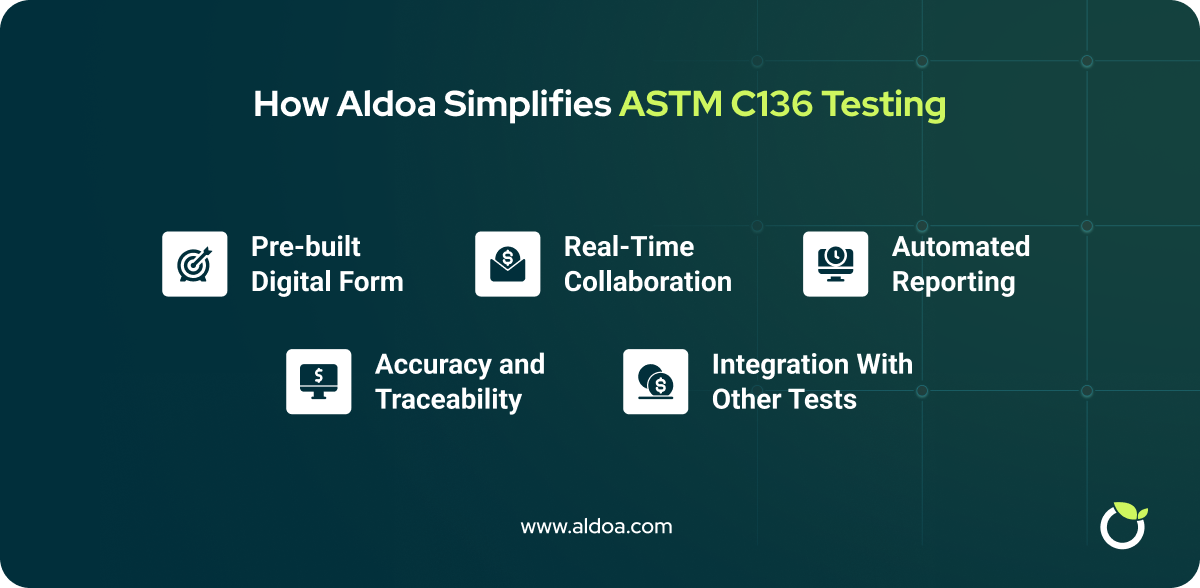
How Aldoa Simplifies ASTM C136 Testing
Aldoa’s form includes all standard sieve sizes and calculation fields—so technicians simply input the retained weight for each sieve. The platform automatically computes cumulative weights, percentages retained, and percentages passing.
2. Automated Reporting
Once data is collected, Aldoa instantly generates ASTM C136 reports formatted for project documentation or client submission—complete with tables, summaries, and gradation visuals.
3. Real-Time Collaboration
Data syncs automatically from field to lab and office. Whether you’re weighing samples or approving results, everyone sees the same information in real time.
4. Accuracy and Traceability
Aldoa’s form prevents calculation errors, missing entries, and inconsistent reporting. Each test is time-stamped and stored securely for future reference or audit.
5. Integration with Other Tests
CMT labs often perform ASTM C136 alongside other aggregate or concrete tests (e.g., ASTM C127 – Specific Gravity, ASTM C128 – Absorption of Fine Aggregate). Aldoa allows users to link these results together for full mix-design traceability.
Who Uses ASTM C136 Testing?
While ASTM C136 applies to both geotechnical and materials testing workflows, it’s most commonly performed by Construction Materials Testing (CMT) laboratories.
CMT labs use it to:
- Validate aggregate sources for concrete and asphalt plants
- Meet project quality control and assurance specifications
- Monitor daily material consistency for production batches
Geotechnical engineers occasionally perform sieve analysis for site characterization, particularly when evaluating drainage materials or aggregate bases—but they more often rely on ASTM D6913 or D422 for soil particle-size distribution.
Benefits of Automating ASTM C136 with Aldoa
- Faster turnaround: Complete tests and reports in minutes
- Improved accuracy: Built-in formulas and validations eliminate calculation errors
- Data consistency: Standardized templates ensure every report meets ASTM and DOT expectations
- Cloud access: Securely access and share reports anytime, anywhere
- Scalability: Manage multiple projects and test types from one unified platform
By digitizing ASTM C136 testing, labs can increase productivity, improve client satisfaction, and focus on analysis rather than admin work.
FAQs About ASTM C136
1. What is ASTM C136 used for?
ASTM C136 determines the particle-size distribution of aggregates used in concrete, asphalt, and base materials. It ensures the mix contains the right balance of fine and coarse particles for strength and durability.
2. What’s the difference between ASTM C136 and ASTM D6913?
ASTM C136 is designed for aggregates (gravel, crushed stone, sand), while ASTM D6913 is used for soils in geotechnical testing.
3. What equipment do I need for ASTM C136?
You’ll need a balance, standard sieves, sieve shaker, drying oven, and a pan and cover for collection.
4. How can software help with ASTM C136?
Software like Aldoa automates calculations, syncs field and lab data, and generates ready-to-send ASTM-compliant reports—saving labs hours of manual work.
5. Is ASTM C136 required for concrete quality control?
Yes. Aggregate gradation determined by ASTM C136 is a fundamental part of concrete and asphalt mix design validation.
Conclusion
ASTM C136 sieve analysis is one of the most important tests in construction materials quality control. Accurate gradation data ensures reliable concrete, asphalt, and aggregate performance. However, manual workflows slow labs down and increase the risk of errors.
Aldoa modernizes ASTM C136 testing with digital forms, automated calculations, and one-click reporting, dramatically reducing turnaround time and improving data quality.
If your CMT lab wants faster results, cleaner data, and consistent ASTM C136 reporting, learn more and schedule a demo at www.aldoa.com/demo.
.svg "Aldoa Assets (3)")