What Is ASTM C78/C78M?
ASTM C78/C78M is the standard test method used to determine the flexural strength (modulus of rupture) of concrete beams using third-point loading. It is most commonly applied to pavements, slabs, bridge decks, and other concrete elements where bending performance governs design.
This test measures how concrete performs in tension under bending, which is often more representative of in‑service performance than compressive strength alone. Many CMT and geotechnical labs manage ASTM C78 results alongside other concrete tests using modern field and lab data management software built specifically for CMT workflows.
Why ASTM C78/C78M Matters for CMT & Geotechnical Firms
Flexural strength testing plays a growing role in:
- DOT pavement acceptance
- Performance‑based specifications
- Mix design verification
- Fast‑track concrete construction
As infrastructure projects demand faster turnaround and higher data quality, labs need ASTM‑compliant workflows that minimize manual effort and reduce risk.
What Is ASTM C78/C78M?
ASTM C78/C78M: Standard Test Method for Flexural Strength of Concrete (Using Simple Beam with Third‑Point Loading) defines the procedure for determining the modulus of rupture (MOR) of molded or sawed concrete beams.
Test objective: Determine the tensile strength of concrete in bending.
Common specimen sizes
- 6 in × 6 in × 21 in beams
- Other dimensions permitted by project specifications
Typical applications
- Concrete pavements and slabs on grade
- Bridge decks
- Structural beams and girders
Because many pavement designs are governed by flexural performance, ASTM C78 is a core quality control test for DOT and infrastructure work.
Key Parameters in ASTM C78/C78M Testing
Accurate flexural strength results depend on capturing the right measurements and applying the correct calculations.
| Parameter |
Description |
Example Field Type in Aldoa |
| Date Sampled / Tested |
Tracking specimen age |
Date field |
| Age |
Calculated from sampling to testing |
Auto-calculated field |
| Average Depth (d) |
Average cross-section depth of beam |
Number field (in) |
| Average Width (b) |
Average cross-section width of beam |
Number field (in) |
| Span Length (L) |
Support span for testing |
Number field (in) |
| Maximum Load (P) |
Force applied until fracture |
Number field (N) |
| Distance Between Fracture |
Location of fracture relative to supports |
Number field (in) |
| Modulus of Rupture (MOR) |
Calculated flexural strength = (P × L) ÷ (b × d²) |
Calculated field |
Without modern software, these values are often handwritten, retyped, and recalculated manually, which increases the risk of error.
ASTM C78 Modulus of Rupture Formula
For third‑point loading with fracture occurring in the middle third of the span, ASTM C78 uses:
R=P×L / BxD^2
Where:
- R = modulus of rupture (flexural strength)
- P = maximum applied load
- L = span length
- b = average width of the specimen at the fracture
- d = average depth of the specimen at the fracture
Correct unit handling is essential. For example, if P is in pounds and dimensions are in inches, R is typically given in psi. If P is in Newtons and dimensions are in millimeters, the result is in MPa.
In Aldoa, this equation is built into the digital form so technicians do not have to perform any manual calculations.
ASTM C78 vs ASTM C39: Flexural Strength vs Compressive Strength
ASTM C78 and ASTM C39 are both widely used concrete strength tests, but they measure different performance characteristics. ASTM C78 evaluates flexural strength using beam specimens and third-point loading, while ASTM C39 measures compressive strength using cylindrical specimens under axial load.
Most CMT labs run both tests as part of pavement and structural concrete programs, which is why Aldoa supports compressive strength testing and flexural strength testing within the same connected platform.
ASTM C78 Flexural Strength Test: Step‑by‑Step Workflow
1. Prepare and cure specimens
- Mold beams in accordance with the applicable concrete standard.
- Cure specimens under specified conditions until the required test age.
- Mark identification and casting dates clearly so age can be calculated.
2. Measure specimen dimensions
- Measure the width and depth of each beam at three locations around the anticipated fracture area.
- Record measurements and compute average b and d.
3. Set up the testing machine
- Place the beam on the supports with the correct span length L.
- Ensure that third point loading heads are positioned accurately at one third points.
4. Apply load to failure
- Load the specimen at a controlled rate.
- Record the maximum load P at the moment of fracture.
- Note the location of the fracture relative to the supports.
5. Calculate modulus of rupture
- Use the appropriate equation from ASTM C78 based on fracture position.
- Document the calculated modulus of rupture along with specimen age and conditions.
6. Report results
A complete report typically includes:
- Project and specimen IDs
- Dimensions, span, and loading configuration
- Age at test
- Maximum load and calculated MOR
- Fracture description and whether results are acceptable per specification
Common Challenges With ASTM C78 Without Modern Software
Labs relying on paper, Excel, or legacy systems often face:
- Manual data transcription between field sheets, spreadsheets, and reports
- Formula and unit errors during modulus of rupture calculations
- Slow report turnaround using Word or PDF templates
- Limited traceability back to mix designs, batches, or related tests
These challenges often extend beyond flexural testing, which is why many labs evaluate a purpose-built LIMS designed for construction materials testing and geotechnical labs rather than generic laboratory systems.
How Aldoa Simplifies ASTM C78/C78M Testing
Aldoa provides a single, connected workflow for flexural strength testing across field and lab teams.
1. Digital ASTM C78 test forms
- Technicians enter specimen dimensions, span length, age, and test loads directly into Aldoa.
- Required fields ensure that no critical data is missed.
- Dropdowns standardize mix IDs, test locations, and specifications.
Example of a digital ASTM C78 flexural strength test form in Aldoa, showing specimen dimensions, applied load, and automatically calculated modulus of rupture.
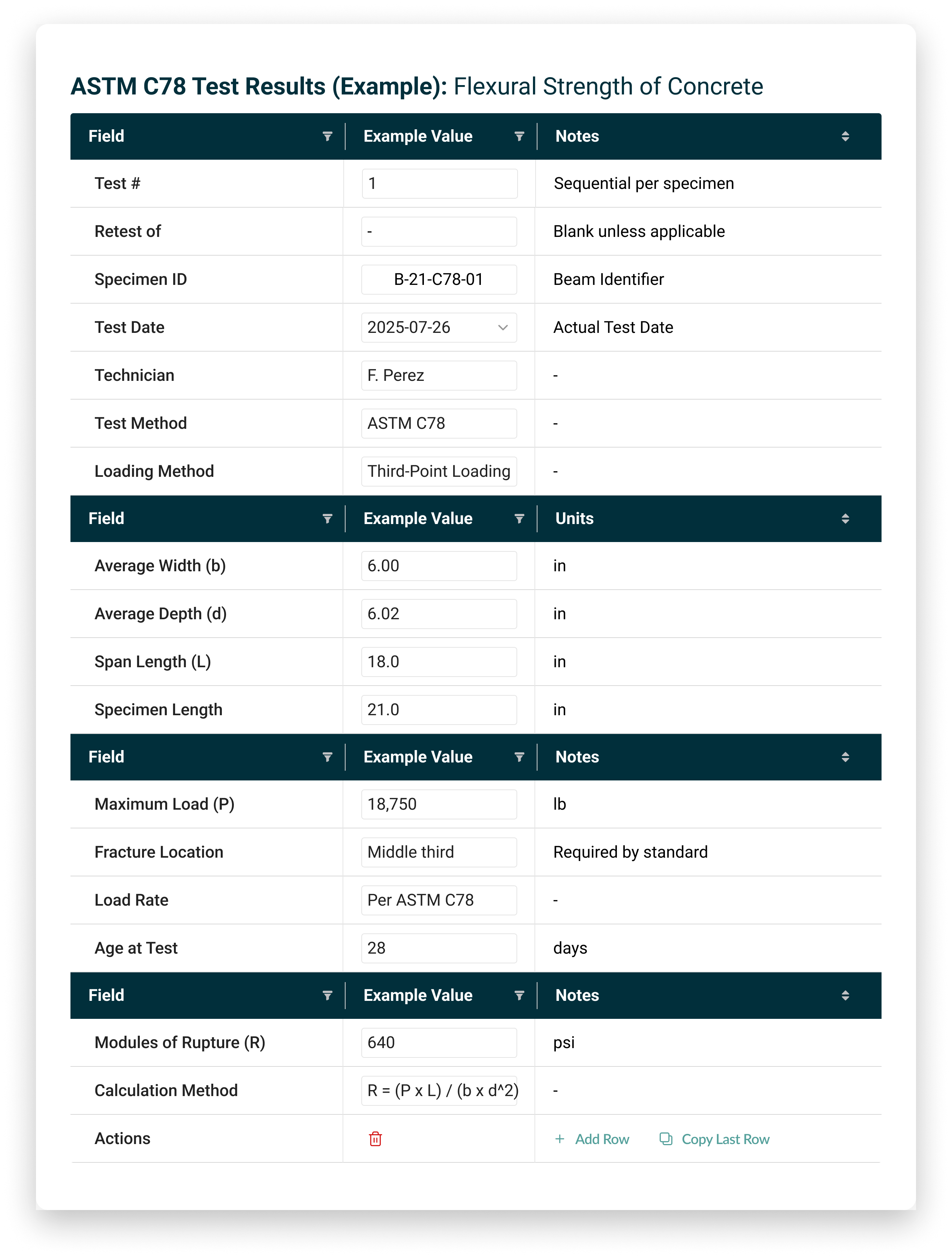
2. Automatic modulus of rupture calculations
- The C78 equation is embedded in the form.
- As soon as technicians enter P, L, b, and d, Aldoa calculates MOR.
- The platform enforces consistent units and flags out of range values.
3. Real time field and lab data collection
- Tests can be recorded on any connected device.
- Results sync instantly and are available to project managers, engineers, and QC staff without emailing spreadsheets.
4. One click ASTM C78 reporting
- Aldoa generates clean, professional reports that include:
- All specimen details and dimensions
- Calculated modulus of rupture
- Technician and reviewer information
- Any notes or project specific requirements
Example of a client-ready ASTM C78 flexural strength report generated in Aldoa.
.png?width=1892&height=2186&name=Flexural%20Strength%20of%20Concrete%20(1).png)
This reporting approach is consistent across concrete, soils, and aggregate tests, giving teams a standardized way to deliver client-ready test reports without manual formatting.
Benefits for Geotechnical and CMT Firms
| Benefit |
Impact on the lab and project team |
| Faster workflows |
Less time spent on manual entry and MOR calculations |
| Higher accuracy |
Automated formulas and validations reduce human error |
| ASTM consistent reporting |
Standardized reports support DOT and QA requirements |
| Real time visibility |
Engineers and PMs see results as soon as tests are completed |
| Stronger client relationships |
Faster, clearer reports improve trust and repeat work |
Example: From Sample To Report In Aldoa
- Specimens created with IDs, mix, and casting dates
- C78 test completed with dimensions, span, and load
- MOR calculated automatically using ASTM rules
- Supervisor review and approval
- Final report generated and shared as PDF
- The result is a complete, auditable ASTM C78 workflow without spreadsheets or retyping.
Why ASTM C78 Testing Matters More Than Ever
Infrastructure programs, DOT performance specifications, and tighter quality expectations have increased the importance of flexural strength testing. Pavement designs, fast track construction, and performance based specifications all rely on accurate flexural data.
Labs that modernize their C78 workflows gain:
- Faster turnaround for time sensitive projects
- Better quality control across batches and suppliers
- Stronger evidence when evaluating mix designs and troubleshooting failures
Aldoa helps labs deliver that level of performance by combining field data collection, automatic calculations, and reporting in a single platform designed for end-to-end concrete testing workflows.
Conclusion: Simplify ASTM C78/C78M Testing With Aldoa
The ASTM C78/C78M flexural strength test is a cornerstone of concrete performance evaluation. The test itself is standardized and well understood. The friction comes from how data is captured, calculated, and reported.
With Aldoa, geotechnical and CMT firms can:
- Use digital ASTM C78 forms that match how technicians actually work
- Automate modulus of rupture calculations and unit handling
- Generate ASTM compliant reports with one click
- Maintain full traceability from specimen creation to final report
By reducing errors and saving time, Aldoa lets your team focus on delivering accurate, reliable test results rather than managing spreadsheets.
.svg "Aldoa Assets (3)")