Compressive strength of concrete is calculated by dividing the maximum compressive load (in pounds-force) by the cross-sectional area of the cylinder (in square inches), giving a result in psi. Standard 28-day strengths range from 2,500 psi for residential slabs to 6,000+ psi for high-rise structural elements. The test method is ASTM C39, performed on cylinder specimens cured for 7, 14, or 28 days.
This guide explains:
- What compressive strength of concrete means
- How it is calculated
- Standard testing procedures
- ASTM standards that apply
- Factors that influence strength
- Typical strength values
- How modern CMT labs streamline reporting
If you are looking specifically for the ASTM laboratory procedure, see our in-depth guide to ASTM C39 Compressive Strength of Concrete.
What Is Compressive Strength of Concrete?
Compressive strength of concrete is the maximum compressive stress that concrete can withstand before failure.
It is typically measured in:
- Pounds per square inch (psi) in the United States
- Megapascals (MPa) internationally
In simple terms, compressive strength tells us how much load concrete can carry before it crushes.
Because concrete is much stronger in compression than in tension, compressive strength is the primary measure used in structural design.
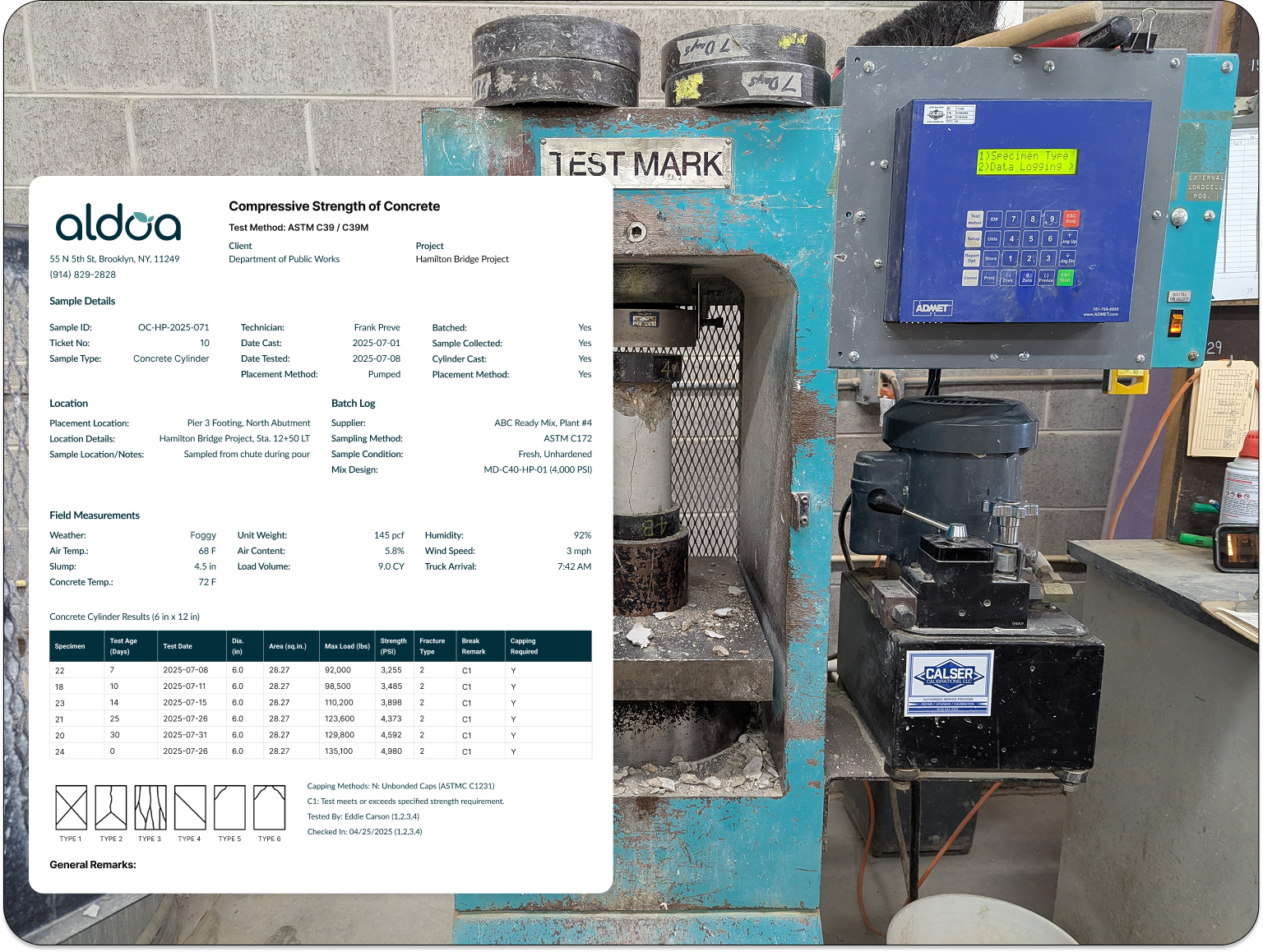
ASTM C39 compressive strength of concrete test showing a cylinder break machine in a CMT laboratory with an Aldoa digital test report displaying max load, PSI calculation, and fracture type.
Why Compressive Strength Matters
Concrete strength determines:
- When formwork can be removed
- When post-tensioning can occur
- When loads can be applied
- Whether a structure meets design requirements
- Long-term durability performance
Insufficient compressive strength can result in structural cracking, settlement, costly remediation, or safety risks.
The compressive strength of concrete is calculated using:
Compressive Strength (f’c) = Maximum Load / Cross-Sectional Area
For cylindrical specimens: f’c=P/A
Where:
- P = Maximum load at failure
- A = Cross-sectional area of the specimen
For a standard 6 × 12 inch cylinder:
- Diameter = 6 inches
- Area = 28.27 square inches
If the cylinder fails at 140,000 pounds: f’c=140,000÷28.27=4,952psi
Typical Compressive Strength Values
Concrete strength varies based on mix design and project requirements.
Common strength ranges:
- Residential slabs: 2,500–3,000 psi
- Sidewalks and driveways: 3,000–4,000 psi
- Commercial slabs: 4,000–5,000 psi
- Structural columns and beams: 5,000–8,000+ psi
- High-performance concrete: 10,000 psi and above
Most design specifications reference the 28-day compressive strength.
How Compressive Strength of Concrete Is Tested
Concrete compressive strength is typically measured using cylindrical specimens prepared and cured under controlled conditions.
Standard Specimen Sizes
- 6 × 12 inch cylinders
- 4 × 8 inch cylinders
Common Test Ages
- 7 days
- 14 days
- 28 days
- Project-specific ages
ASTM Standards for Compressive Strength Testing
Several ASTM standards apply to compressive strength testing.
ASTM C39: Standard test method for compressive strength of cylindrical concrete specimens.
ASTM C31: Making and curing concrete test specimens in the field.
ASTM C192: Laboratory preparation and curing of specimens.
ASTM C617 / C1231: Capping and end preparation methods.
For a detailed breakdown of procedure, calculations, and digital workflows, read our full guide to ASTM C39 Compressive Strength Testing.
Concrete testing goes beyond cylinder breaks. From field sampling and curing to compressive strength verification and compliance documentation, modern concrete testing workflows demand traceability, accuracy, and fast turnaround.
Learn more about digital Concrete Testing workflows.
Step-by-Step Concrete Cylinder Break Test Procedure
Below is a simplified overview of the ASTM C39 procedure.
1. Measure the Cylinder: Verify diameter and record dimensions.
2. Check End Preparation: Ensure proper capping or grinding per ASTM standards.
3. Center in Compression Machine: Align specimen to prevent eccentric loading.
4. Apply Load at Controlled Rate: Loading rate must meet ASTM specifications.
5. Record Maximum Load: Capture peak load at failure.
6. Calculate Strength: Divide maximum load by cross-sectional area.
7. Document Break Type: Record fracture pattern and any irregularities.
Types of Concrete Failure Patterns
Common fracture types include:
- Cone failure
- Shear failure
- Splitting failure
- Columnar fracture
Break type classification provides insight into specimen preparation and testing accuracy.
Factors That Affect Compressive Strength
Several variables influence strength results:
Among these, water-cement ratio is the most significant determinant of strength.
7-Day vs 28-Day Compressive Strength
Concrete does not reach full strength immediately.
Typical development pattern:
- 7 days: ~65–75% of 28-day strength
- 14 days: ~85–90%
- 28 days: Design strength achieved
- 56+ days: Continued strength gain
Engineers use early break results to predict 28-day performance.
What Happens If Concrete Fails Strength Requirements?
If compressive strength is below specification:
- Additional cores may be taken
- Load testing may be required
- Structural analysis may be performed
- Remedial strengthening may occur
Accurate testing and reporting are critical because results have legal and financial implications.
Compressive Strength Testing in CMT Laboratories
Construction Materials Testing (CMT) labs perform thousands of cylinder breaks per year.
Typical workflow includes:
- Field sample collection
- Cylinder identification and tracking
- Curing management
- Break scheduling
- Strength calculation
- Reporting and client communication
Manual workflows often rely on paper tickets, spreadsheets, and disconnected break machines. These processes introduce transcription errors and reporting delays.
Compressive strength testing is one of the highest-volume services performed by Construction Materials Testing (CMT) laboratories. Modern CMT teams are moving beyond spreadsheets and paper break sheets toward connected platforms that unify field sampling, cylinder tracking, break testing, and ASTM-compliant reporting in one system.
Explore how digital workflows are transforming Construction Materials Testing.
Modernizing Compressive Strength Reporting
While the ASTM test procedure remains standardized, the workflow supporting it has evolved.
Modern lab platforms:
- Capture field sample data digitally
- Track cylinders through curing
- Integrate with break machines
- Calculate strength automatically
- Validate loading rates
- Generate consistent PDF reports
- Maintain audit trails
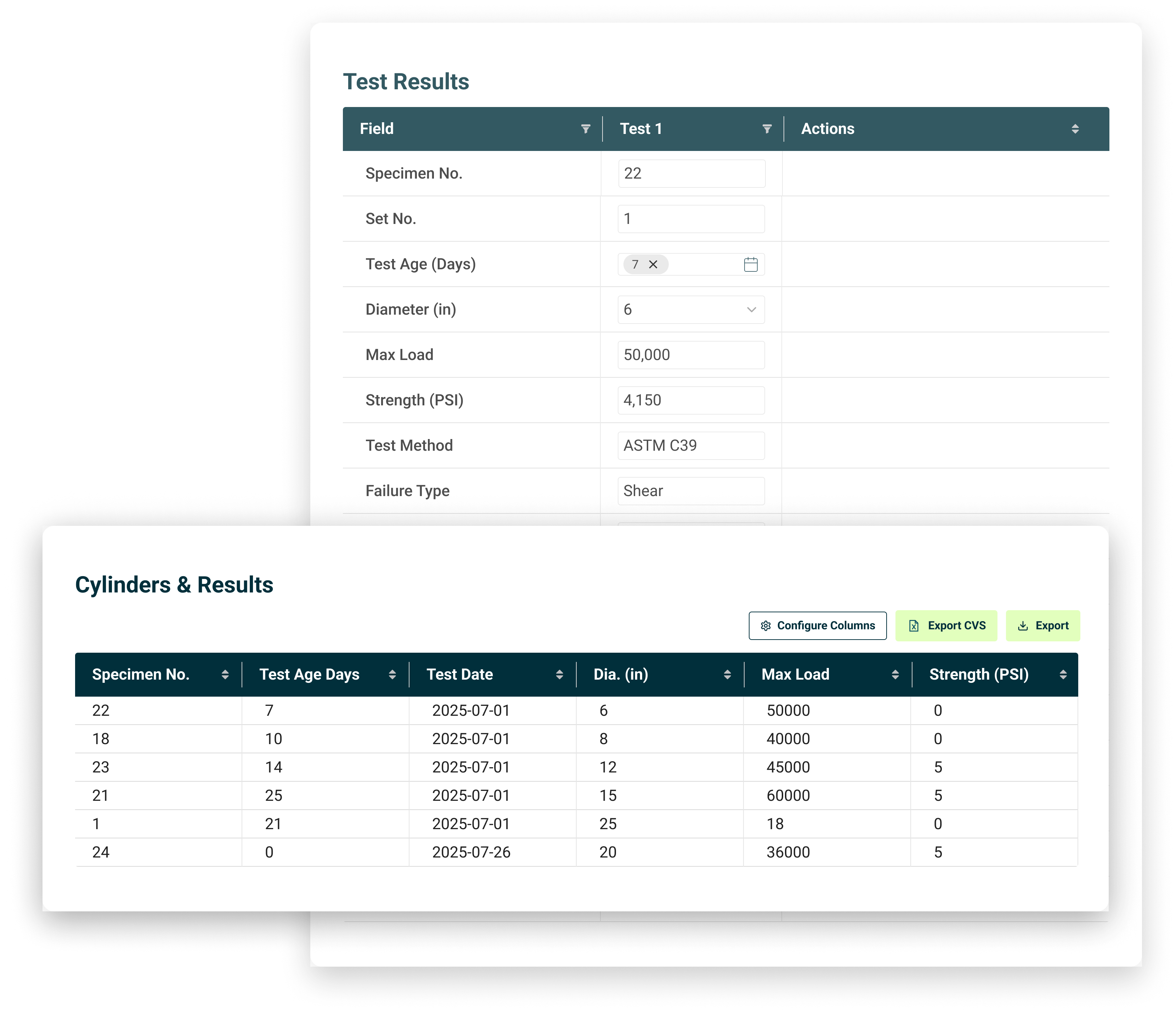
This reduces administrative burden and improves compliance with ASTM and ACI requirements.
Frequently Asked Questions About Compressive Strength of Concrete
What is the compressive strength of concrete?
It is the maximum compressive stress concrete can withstand before failure, typically measured in psi or MPa.
What is f’c in concrete?
f’c represents the specified compressive strength used in structural design calculations.
Why is 28-day strength used?
Concrete reaches most of its design strength within 28 days under standard curing conditions.
How is compressive strength calculated?
By dividing the maximum load at failure by the cross-sectional area of the specimen.
What ASTM standard covers compressive strength?
ASTM C39 covers compressive strength of cylindrical concrete specimens.
Compressive Strength in Structural Design
Structural engineers use compressive strength values to determine:
- Load capacity
- Column sizing
- Reinforcement requirements
- Shear capacity
- Durability considerations
The specified compressive strength (f’c) is central to ACI 318 design equations.
The Future of Concrete Strength Testing
The physical break test has not changed significantly in decades.
What has changed is:
- Data capture
- Sample tracking
- Machine integration
- Report automation
- Audit transparency
CMT labs that modernize their workflows reduce reporting time, eliminate spreadsheet errors, and improve client satisfaction without altering ASTM procedures.
Conclusion
Compressive strength of concrete is the most critical quality metric in structural construction. Accurate measurement ensures safety, durability, and compliance with engineering design requirements.
While the testing method remains standardized under ASTM C39, the workflow surrounding compressive strength testing continues to evolve.
For a detailed breakdown of ASTM C39 procedures and how modern labs streamline reporting, read our complete guide to ASTM C39 Compressive Strength Testing.
If your CMT lab is ready to eliminate spreadsheets, accelerate cylinder break reporting, and maintain full ASTM C39 compliance, schedule a demo to see how Aldoa modernizes compressive strength testing workflows.
.svg "Aldoa Assets (3)")