Borehole logging software has become a core part of modern geotechnical workflows. As project volumes increase and expectations around data quality rise, firms are moving away from spreadsheets and paper logs toward digital systems that standardize soil boring logs and connect field, lab, and reporting teams.
This guide explains what borehole logging software is, the key features to look for, and how leading platforms compare in 2026.
For a deeper technical foundation, see our complete guide to soil boring logs.
What is Borehole Logging Software?
Borehole logging software helps geotechnical teams capture, organize, and report subsurface data from drilling investigations. It standardizes fields like sample intervals, recovery, SPT N values, USCS classifications, groundwater readings, and photos. Modern platforms connect field capture with lab tests and final reporting so data flows from the borehole to the client without retyping.
How Borehole Logging Software Supports Soil Boring Logs
Soil boring logs are one of the most important deliverables in geotechnical engineering. Borehole logging software ensures these logs are:
- Captured consistently across crews and projects
- Complete and defensible for review and reporting
- Easily shared between field, lab, and PM teams
Digital workflows reduce errors, shorten turnaround time, and make it easier to scale boring log production without adding administrative overhead.
You can see a practical example in our annotated soil boring log example.
Key Features to Look For
When evaluating borehole logging software, look for tools that do more than just digitize your field forms. The best systems connect data from the field, lab, and reporting teams so information moves smoothly through every stage of a project. Here’s what to prioritize:
Digital boring logs: Your software should provide structured digital forms that mirror real-world drilling workflows. Each field — from sample intervals, recovery percentages, and SPT N-values to USCS classifications and moisture content — should be standardized across projects. The ability to record inclusions, layer boundaries, and groundwater levels in one view ensures complete and defensible documentation. Look for systems that also support photo attachments and GPS location tracking so every boring log tells a full, visual story of the subsurface.
Field data capture: Crews need tools that work in real field conditions — including remote sites and low connectivity. Mobile-friendly forms allow technicians to log data in real time, even offline, and automatically sync when service returns. Built-in technician assignments, maps, and turn-by-turn navigation keep projects on schedule. The goal is to remove guesswork from the field so data arrives clean, complete, and ready for analysis.
Lab integration: The most efficient geotechnical workflows connect the field and lab. Modern borehole logging software lets field staff create or trigger lab tests directly from their logs, giving the lab visibility into incoming work before the samples even arrive. As results are entered, they automatically populate back into the corresponding boring log, eliminating manual data entry and reducing errors.
Report generation: Your team shouldn’t have to spend hours formatting logs or copying data into templates. Look for platforms that generate professional boring logs, cross sections, and well diagrams with just a few clicks. Consistent, client-ready PDFs and flexible export options (like CSV or custom report formats) ensure every deliverable looks polished and accurate.
Workflow and compliance: Beyond logging, leading systems handle scheduling, dispatch, and certification tracking so every assignment is covered by the right personnel. Built-in audit trails and role-based permissions maintain accountability, helping firms meet QA/QC and accreditation requirements.
Data portability: Avoid tools that trap your information. Your software should let you export data easily through CSV files or API integrations so you can share with design tools, reporting platforms, or regulatory systems. True data ownership gives your firm long-term flexibility and independence.
Benefits of Moving from Excel to Cloud Based Logging
Many geotechnical firms still rely on spreadsheets or paper logs, but the inefficiencies become clear as soon as project volume increases. Moving to cloud-based borehole logging software transforms how teams operate — from data accuracy to client delivery.
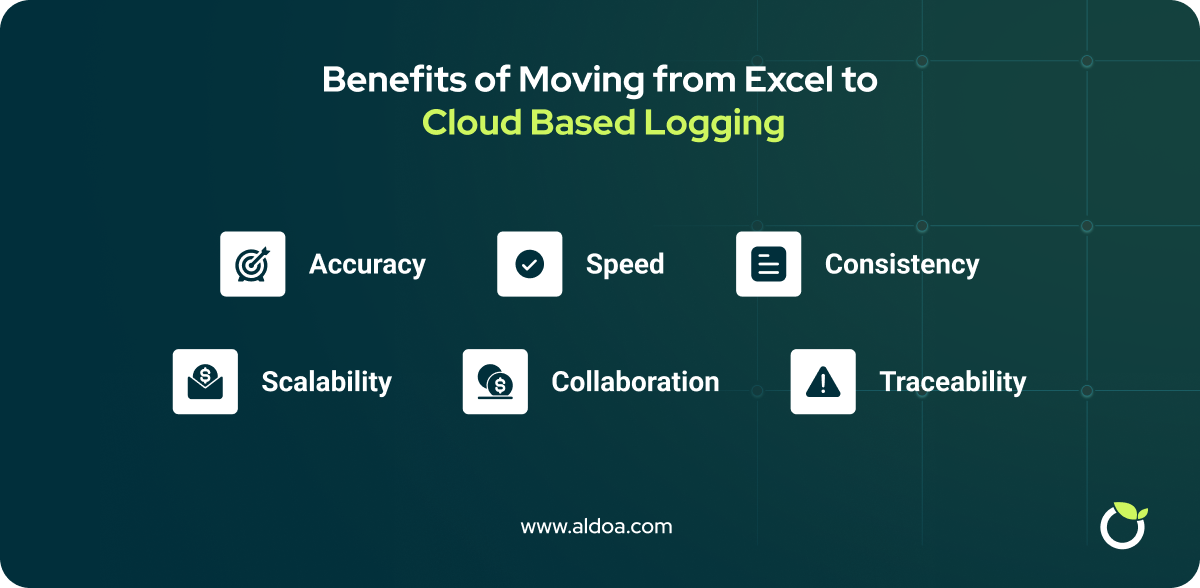
- Accuracy: Single entry at the source reduces transcription errors.
- Speed: Lab sees incoming work early. Reports assemble faster.
- Consistency: Standard forms and controlled vocabulary.
- Traceability: Photos, timestamps, GPS, and who did what and when.
- Collaboration: Field, lab, and PMs share the same live record.
- Scalability: Templates and workflows scale across projects and offices.
Comparison of Top Borehole Logging Software in 2026
Quick read summary to help short list. Your needs may vary by project type, client deliverables, and existing lab stack.
Snapshot table
| Product |
Best fit |
Strengths |
Considerations |
| Aldoa |
Geotechnical firms that want one workflow from scheduling to report, plus CMT and lab visibility |
Clean field capture, lab workflow, report generation, ForneyVault integration, modern API, quick to configure |
Newer cross sections and advanced CAD exports may require roadmap review |
| gINT (Bentley) |
Firms with legacy gINT libraries and deep custom reports |
Mature reporting, wide industry adoption, robust templates |
Desktop centric, heavier admin, slower field to lab flow without add ons |
| Stonemont Darwin |
Firms focused on aggregates and materials with some boring log needs |
Materials data strength, QC focus |
Geotechnical boring workflows are not the primary design goal |
How This Fits into a Modern Soil Boring Log Workflow
Borehole logging software works best when it is part of a broader digital soil boring log workflow that connects:
- Field data collection
- Lab testing
- Engineering review
- Client reporting
Modern platforms eliminate manual handoffs and ensure all teams work from the same source of truth. For a deeper look at this workflow, see Digital Soil Boring Logs: Benefits for Geotechnical Firms.
Conclusion: Digitizing Borehole Logging Is No Longer Optional
The shift to digital borehole logging software is about more than technology. It transforms how geotechnical teams operate.
Cloud-based systems reduce errors, speed reporting, and improve visibility across projects. Engineers spend less time cleaning up data and more time interpreting results. Clients receive deliverables faster. Management gains real-time insight into progress.
Aldoa is built for this modern standard. It connects field data collection, lab coordination, and reporting in one intuitive platform designed specifically for geotechnical and CMT teams.
If your firm is still relying on spreadsheets or disconnected tools, this is the moment to modernize.
.svg "Aldoa Assets (3)")