Soil boring logs are standardized records used by geotechnical engineers to document subsurface conditions encountered during drilling. They capture soil and rock descriptions, sample depths, groundwater observations, and in-situ test results that directly inform foundation design, earthwork planning, and construction risk management.
Accurate soil boring logs are critical because they influence safety, cost, and project timelines. Incomplete or inconsistent logs can lead to design errors, change orders, and delays, especially when field notes are recorded on paper or transferred manually into spreadsheets after drilling.
This guide explains what a soil boring log is, what information it should include, and how geotechnical engineers use boring logs to interpret subsurface conditions. It also shows how modern software like Aldoa helps teams create consistent, client-ready boring logs faster by connecting field and lab data in a single workflow.
What is a soil boring log?
A soil boring log is a record of subsurface conditions observed and sampled during drilling. It typically includes location and elevation, drilling method, sample intervals and recovery, blow counts, lithology, groundwater conditions, photos, and notes that together form a defensible profile for design.
.png?width=730&height=1000&name=A4%20-%20filled%20(4).png)
Why soil boring logs matter in geotechnical engineering
- Risk reduction: Early visibility into weak or variable strata prevents surprises during construction.
- Design efficiency: Bearing capacity, settlement predictions, and groundwater control all rely on accurate subsurface data.
- Regulatory compliance: Many permits and public agency manuals expect borings, pits, or infiltration tests in the vicinity of proposed facilities.
- Client confidence: Clear logs and traceable data build trust and speed approvals.
How many soil borings do you need
The right number depends on site size, variability, structure loads, and local guidance. For small facilities or infiltration practices, one to two explorations might suffice. As area and complexity grow, add locations to capture variability and confirm depth to bedrock and groundwater. A practical rule: increase spacing in uniform sites and tighten spacing in filled, urban, or geologically complex areas.
Tip: If you discover unexpected materials or refusal, add offset borings to reduce uncertainty.
Looking to digitize your boring logs? Modern geotechnical teams are replacing spreadsheets and legacy systems with structured logging workflows. See how it works in Aldoa: Schedule a demo.
Common sampling and drilling methods
| Method |
Typical depth |
Speed |
What it is good for |
Notes |
| Soil probe |
≤ 3 ft |
Fast |
Shallow profile checks |
Limited data, not for design on its own |
| Hand or power auger |
≤ 50 ft |
Moderate |
Unconsolidated soils |
No blow counts with hand auger |
| Test pits |
≤ 20 ft |
Fast |
Visual logging and bulk samples |
Requires excavation equipment and safety controls |
| Direct Push (DPT) |
60–100+ ft |
Fast |
Continuous sampling with minimal cuttings |
No SPT N-values |
| Rotosonic |
100+ ft |
Fast |
Continuous core through difficult formations |
Mobilization costs can be higher |
| Hollow Stem Auger with SPT |
100+ ft |
Moderate |
Foundation investigations, infiltration decisions |
Provides SPT N-values and flexible sampling |
Choose methods that match project goals. If you need blow counts for density or consistency, plan for SPT with hollow stem auger.
Disturbed vs. undisturbed samples
- Disturbed samples (split-spoon, bulk, auger cuttings) are suitable for classification, grain size, and index tests. Split-spoon sampling during SPT also gives you N-values.
- Undisturbed samples (thin-walled tube, Shelby, piston) preserve structure and are used for shear strength and consolidation testing. These are less common for infiltration screening but essential for settlement and strength evaluation.
How to order and manage a boring program
If possible, have a geotechnical engineer onsite during drilling to coordinate locations, adjust intervals when conditions change, and document observations. Clear instructions for drillers will improve outcomes:
- If split-spoon recovery is less than 6 inches, drill two feet deeper and resample.
- When a confining or restrictive layer is suspected, reduce intervals to two feet to bracket the transition.
- Record reasons for low recovery.
- If refusal occurs before target depth, offset and blind drill to previous refusal, then continue with sampling.
- Request complete field logs with soil type, recovery, blow counts, groundwater observations, and photos.
What to include on a boring log
A defensible log has consistent identifiers and complete metadata:
- Boring ID and project information
- Coordinates and ground surface elevation
- Dates and times
- Rig and drilling method
- Sampling method and depths
- Sample recovery
- SPT N-values and remarks on driving resistance
- Soil descriptions with USCS classification, color, moisture, inclusions, and structure
- Layer boundaries and thickness
- Depth to groundwater and subsequent readings
- Depth to bedrock and refusal
- Photos, sketches, and any anomalies
See a real soil boring log example (annotated)
Understanding the theory behind soil boring logs is important. But reviewing a complete example is often the fastest way to improve interpretation skills and field documentation quality.
If you want to see how:
- SPT N-values are recorded and summarized
- Recovery is documented
- Soil layers are delineated
- USCS classifications are applied
- Groundwater observations are noted
- Refusal and bedrock are shown
Review this soil boring log example (annotated) for a step-by-step breakdown of a real borehole log.
The example walks through each column of the log and explains how engineers interpret blow counts, stratigraphy, and groundwater in context. It also highlights common documentation mistakes that digital workflows help eliminate.
Studying a complete example alongside this guide will help you move from theory to practical application.
Pro tip: Use standard forms and controlled vocabulary for soil descriptions to keep logs consistent across crews and projects.
Interpreting boring logs and identifying restrictive layers
Restrictive layers such as dense clays, cemented zones, perched water, or bedrock limit infiltration and can cause perched groundwater. When interpreting logs:
- Focus on the least permeable layer within the design depth because it controls infiltration.
- Compare SPT N-values, plasticity indications, moisture, and color mottling to locate seasonal saturation.
- Confirm layer continuity between borings before making site-wide assumptions.
- If a restrictive layer lies close to the proposed facility elevation, consider alternatives or engineering measures.
Lab tests that support boring log interpretation
- Grain size analysis (ASTM D6913 + D7928 or legacy D422) to classify sands and silts and identify well graded versus poorly graded soils.
- Atterberg limits (ASTM D4318) for plasticity and soil behavior type.
- Moisture content (ASTM D2216) to support groundwater interpretation.
- PSD curves provide clarity when evaluating infiltration potential. If a large fraction passes the No. 200 sieve, infiltration performance will be limited.
Soil Boring Log Software: Why Digital Borehole Logging Is Replacing Paper
Many geotechnical firms still create soil boring logs in:
- Field notebooks
- Excel spreadsheets
- Access databases
- Legacy systems like gINT
This creates problems:
- Double data entry
- Inconsistent USCS classifications
- Missing SPT N-values
- Delays between field and lab
- Manual drafting of final logs
Modern soil boring log software eliminates these issues by structuring field data from the start.
Many firms historically used Bentley gINT for borehole logging. As legacy systems become unsupported or harder to maintain, geotechnical teams are moving toward cloud-based soil boring log software that connects field, lab, and reporting in one workflow.
What to Look for in Borehole Logging Software
If you're evaluating soil boring log software, prioritize:
- Structured capture of SPT blow counts and recovery
- Automatic USCS classification support
- Lab test initiation from the borehole
- Automated boring log generation
- Cross-section and well diagram outputs
- Centralized review and approval workflows
- Cloud access for field and lab teams
.png?width=1954&height=1402&name=Group%2027379%20(1).png)
How Aldoa Streamlines Soil Boring Log Management
Aldoa replaces spreadsheets, shared drives, and legacy borehole logging tools with a single workflow:
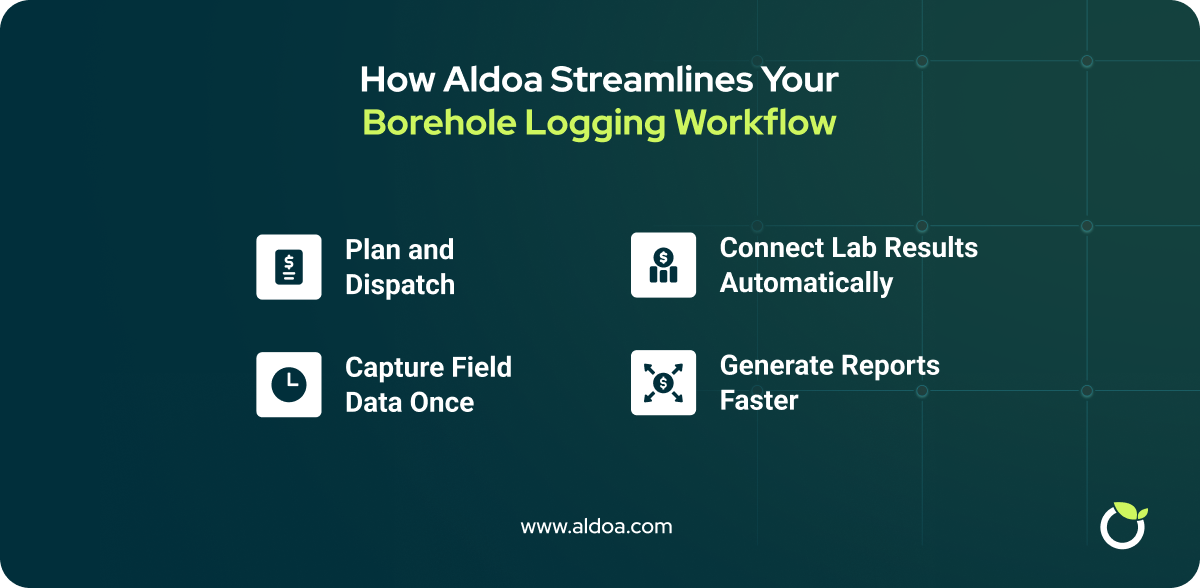
Plan and dispatch: Create work orders, assign the right driller or technician, and attach maps and forms so crews know exactly what to collect.
Capture structured field data: Log sample intervals, recovery, and SPT N-values in structured forms. Attach photos and site notes. Initiate lab tests from the field to give the lab a head start.
- SPT N-values
- Recovery percentages
- Sample depths
- Soil descriptions
- Photos and coordinates
Initiate lab tests instantly: Field crews trigger lab testing from the borehole record. The lab sees upcoming samples before delivery.
Connect lab results automatically: As tests are completed, results flow back into the boring log. No retyping.
Generate client ready reports:
- Professional soil boring logs
- Cross-sections
- Well diagrams
- Consolidated project reports
All from a single source of truth.
👉 See how modern geotechnical teams digitize borehole logging. Schedule a demo.
Common Soil Boring Log Mistakes That Cause Design Errors
Even experienced teams make mistakes that lead to rework:
- Inconsistent soil descriptions between borings
- Missing groundwater follow-up readings
- Misinterpreting refusal as bedrock
- Over-relying on a single boring
- Ignoring low recovery percentages
- Transferring field notes manually into spreadsheets
Digital workflows reduce these risks by enforcing required fields, standard terminology, and real-time validation.
Frequently asked questions about soil boring logs
.svg "Aldoa Assets (3)")