Soil density and compaction testing are critical to ensuring the stability, safety, and long-term performance of foundations, roadways, embankments, and structural fills.
For geotechnical engineering and construction materials testing firms, these tests are performed daily in the field. Yet while the testing methods are standardized under ASTM guidelines, the way data is collected, reviewed, calculated, and reported often remains manual, fragmented, and slow.
This guide explains:
- What soil density and compaction testing are
- Field and laboratory test methods
- Relevant ASTM standards
- How percent compaction is calculated
- Nuclear gauge vs sand cone comparisons
- Common reporting challenges
- How modern digital platforms like Aldoa streamline the entire workflow
.png?width=2400&height=1176&name=9.%20Reusable%20Mid-Article%20CTA%20Blocks%20(1).png)
Soil density and compaction testing are critical quality control procedures in geotechnical engineering and construction materials testing (CMT). Field tests such as nuclear density gauge measurements verify that soil meets required compaction specifications before construction proceeds.
Soil density testing measures the in-place density of compacted soil in the field, while soil compaction testing determines maximum dry density and optimum moisture content in a laboratory. Together, they are used to calculate percent compaction and verify soil meets project specifications.
What Is Soil Density Testing?
Soil density testing measures the in-place density of compacted soil to verify that it meets project specifications.
Density directly affects:
- Bearing capacity
- Settlement performance
- Pavement durability
- Structural stability
In construction, soil is compacted in lifts and tested to confirm it meets a specified percentage of maximum dry density, typically 95 percent or 98 percent of Proctor density.
What Is Soil Compaction Testing?
Soil compaction testing determines how well soil particles are packed together after mechanical compaction. Compaction reduces air voids, increases shear strength, and decreases permeability.
Compaction testing includes two major components:
- Laboratory compaction testing to determine maximum dry density and optimum moisture content
- Field density testing to verify in-place compaction
These two data sets are compared to calculate percent compaction.
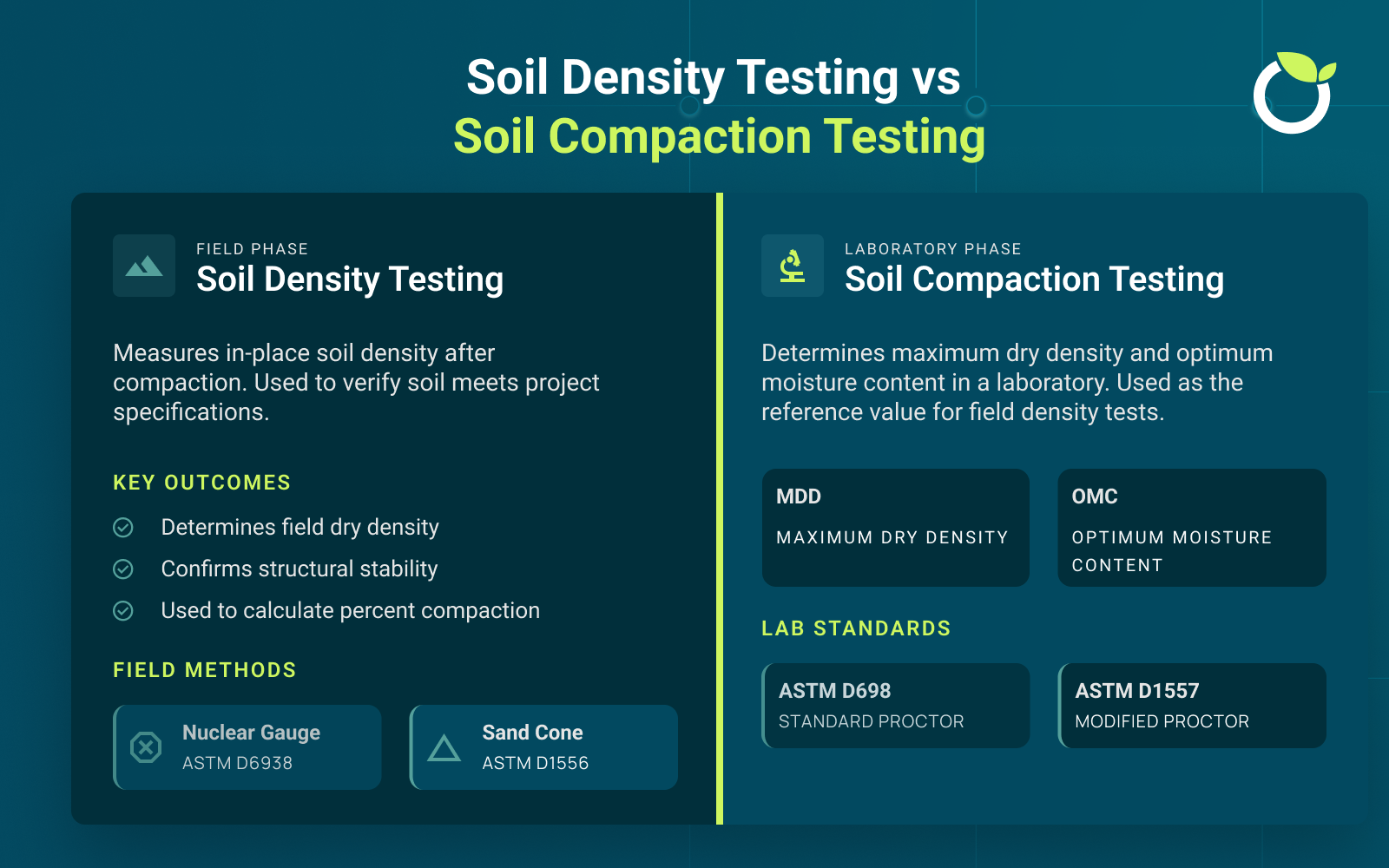
Soil density testing measures in-place field compaction using methods like nuclear gauge and sand cone, while soil compaction testing (Proctor tests) establishes maximum dry density and optimum moisture content in the lab.
Key ASTM Standards for Soil Density and Compaction Testing
Understanding ASTM standards is essential for compliance and defensible reporting.
Field Density Testing Standards
ASTM D6938: In-Place Density and Water Content of Soil and Soil-Aggregate by Nuclear Methods.
This governs nuclear gauge testing and is the most widely used field density method in CMT.
ASTM D1556: Density and Unit Weight of Soil in Place by Sand-Cone Method.
Traditional sand cone method used when nuclear gauges are restricted.
ASTM D2167: Density of Soil in Place by Rubber Balloon Method
Laboratory Compaction Standards
ASTM D698:
- Standard Proctor Test
- Lower compactive effort
- Common for residential and light construction
ASTM D1557:
- Modified Proctor Test
- Higher compactive effort
- Common for highways and heavy civil
Moisture Content Standards
ASTM D2216: Oven-dry moisture determination
Moisture is essential for calculating dry density and percent compaction.
Common Soil Density Testing Methods
1. Nuclear Gauge Testing
Nuclear density gauges measure in-place density and moisture content using radioactive sources.
Advantages:
- Fast results
- Immediate moisture and density readings
- Minimal excavation
Limitations:
- Requires certification and licensing
- Equipment cost
- Regulatory compliance
Primary ASTM Standard: D6938
2. Sand Cone Test
The sand cone method replaces excavated soil with calibrated sand to determine volume.
Advantages:
- No radioactive material
- Accepted by most DOTs
Limitations:
- Slower
- More labor intensive
- Sensitive to wind and field conditions
Primary ASTM Standard: D1556
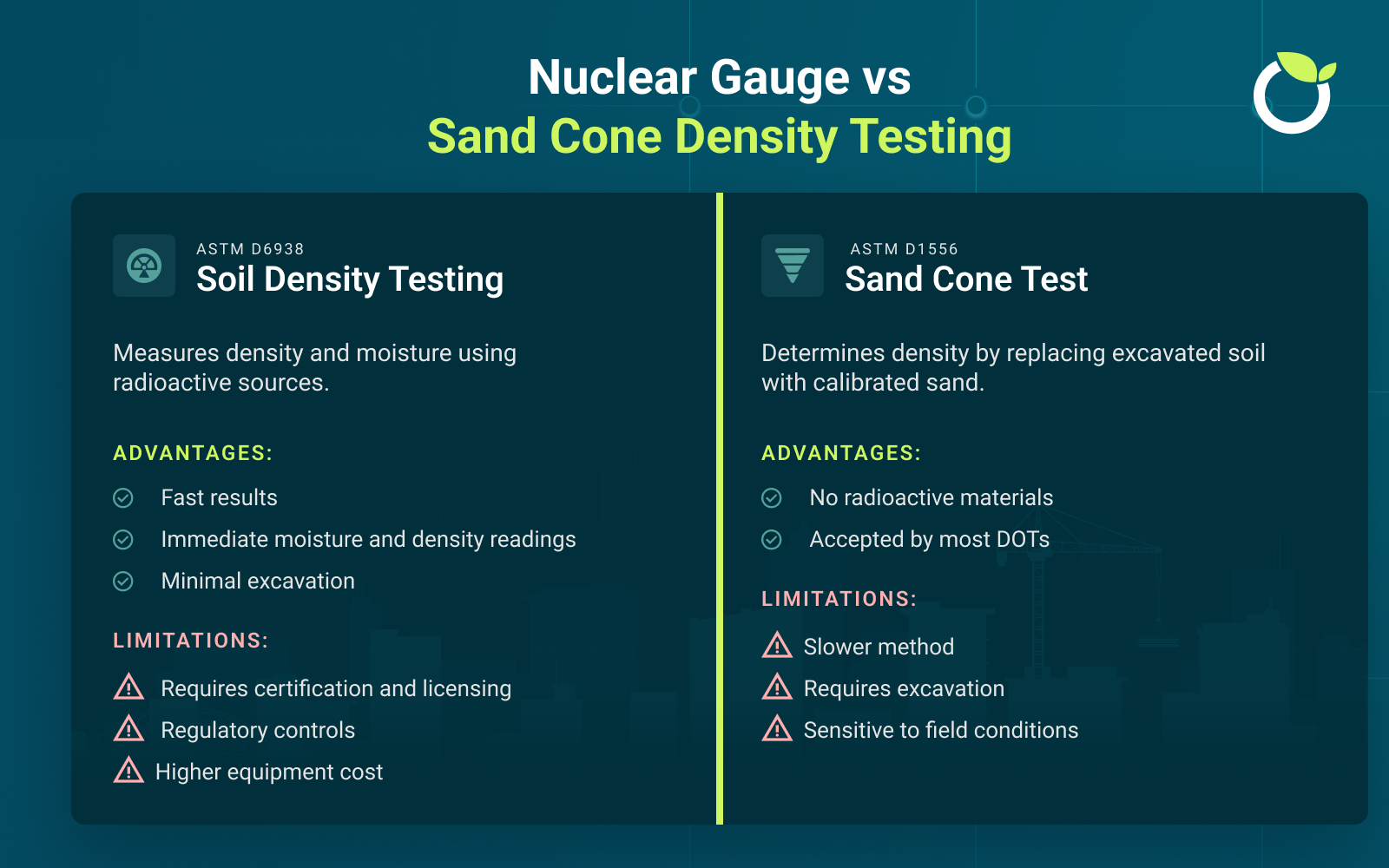
Nuclear density gauge testing (ASTM D6938) provides fast, real-time moisture and density readings, while the sand cone test (ASTM D1556) is a non-nuclear method widely accepted by DOTs but slower and more labor-intensive.
3. Proctor Compaction Test
Performed in the lab to determine maximum dry density and optimum moisture content.
Two versions:
- Standard Proctor ASTM D698
- Modified Proctor ASTM D1557
Field results are compared to Proctor results to determine compliance.
.png?width=1600&height=1000&name=Graphic%204%20Proctor%20Curve%20(Moisture%20vs%20Dry%20Density).png)
The Proctor compaction curve illustrates how dry density increases with moisture content up to the optimum moisture content (OMC), where maximum dry density (MDD) is achieved before decreasing as soil becomes oversaturated.
How Percent Compaction Is Calculated
Percent Compaction =
(Field Dry Density ÷ Maximum Dry Density from Proctor) × 100
Example:
Field Dry Density = 118 pcf
Maximum Dry Density = 122 pcf
Percent Compaction = 96.7%
If the specification requires 95%, this lift passes.
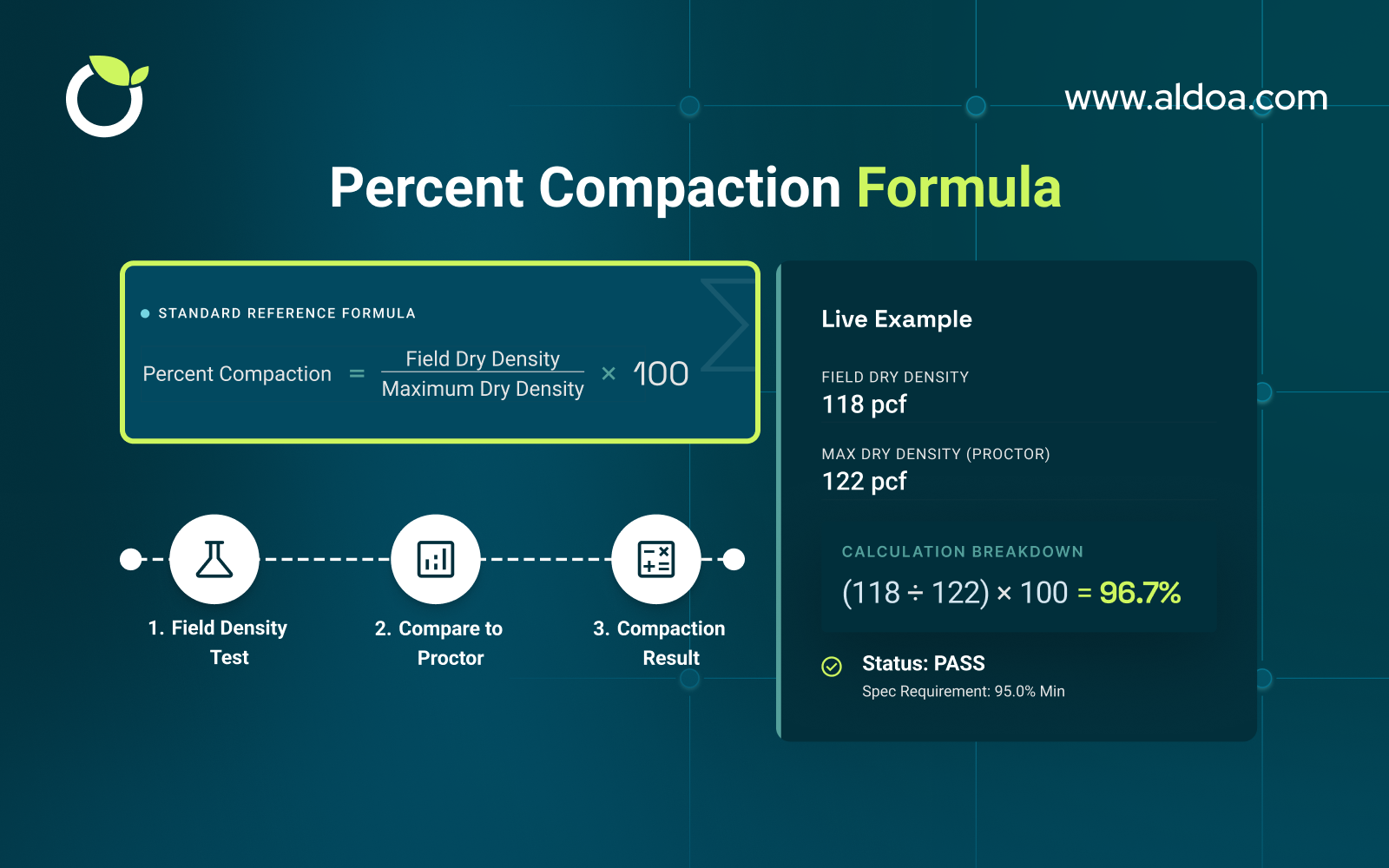
Percent compaction is calculated by dividing field dry density by maximum dry density (Proctor) and multiplying by 100, helping determine whether soil meets project compaction requirements.
Why Soil Density Testing Is Critical in CMT and Geotechnical Engineering
Failing compaction requirements can result in:
- Pavement failure
- Foundation settlement
- Structural cracking
- Costly remediation
Because of this, density testing is one of the most frequently performed field tests in construction materials testing.
The Hidden Challenge: Field Data Management
While ASTM standards clearly define procedures, they do not define how data should be managed.
Many CMT and geotechnical firms still rely on:
- Paper field tickets
- Manual moisture corrections
- Excel spreadsheets
- Re-keying data into reports
- Delayed QA review
- Disconnected lab and field records
This creates:
- Calculation errors
- Reporting delays
- Inconsistent formatting
- Difficulty scaling operations
- Risk during audits
For firms running dozens or hundreds of density tests per week, inefficiencies compound quickly.
How Aldoa Modernizes Soil Density and Compaction Testing
.png?width=1600&height=1000&name=Graphic%205%20Digital%20Density%20Testing%20Workflow%20(Aldoa).png)
A modern density testing workflow digitizes field data collection, automates calculations like dry density and percent compaction, streamlines QA review, and generates standardized reports in one connected system.
Aldoa is a modern field and lab data management platform built specifically for geotechnical and CMT teams. Instead of paper and spreadsheets, Aldoa enables:
Mobile Field Data Capture
Technicians enter:
- Project details
- Lift location
- Gauge readings
- Moisture content
- Depth
- Stationing
- Remarks
All from structured mobile forms. No duplicate entry.
-1.png?width=1930&height=1459&name=Group%2027378%20(1)-1.png)
Digital field density test forms allow technicians to capture soil compaction test data directly on mobile devices. Structured data collection eliminates duplicate entry and ensures field results are immediately available for review and reporting.
Automatic Calculations
Aldoa can:
- Calculate dry density
- Calculate percent compaction
- Compare against Proctor values
- Flag failing tests in real time
This reduces manual math errors and speeds up QA.
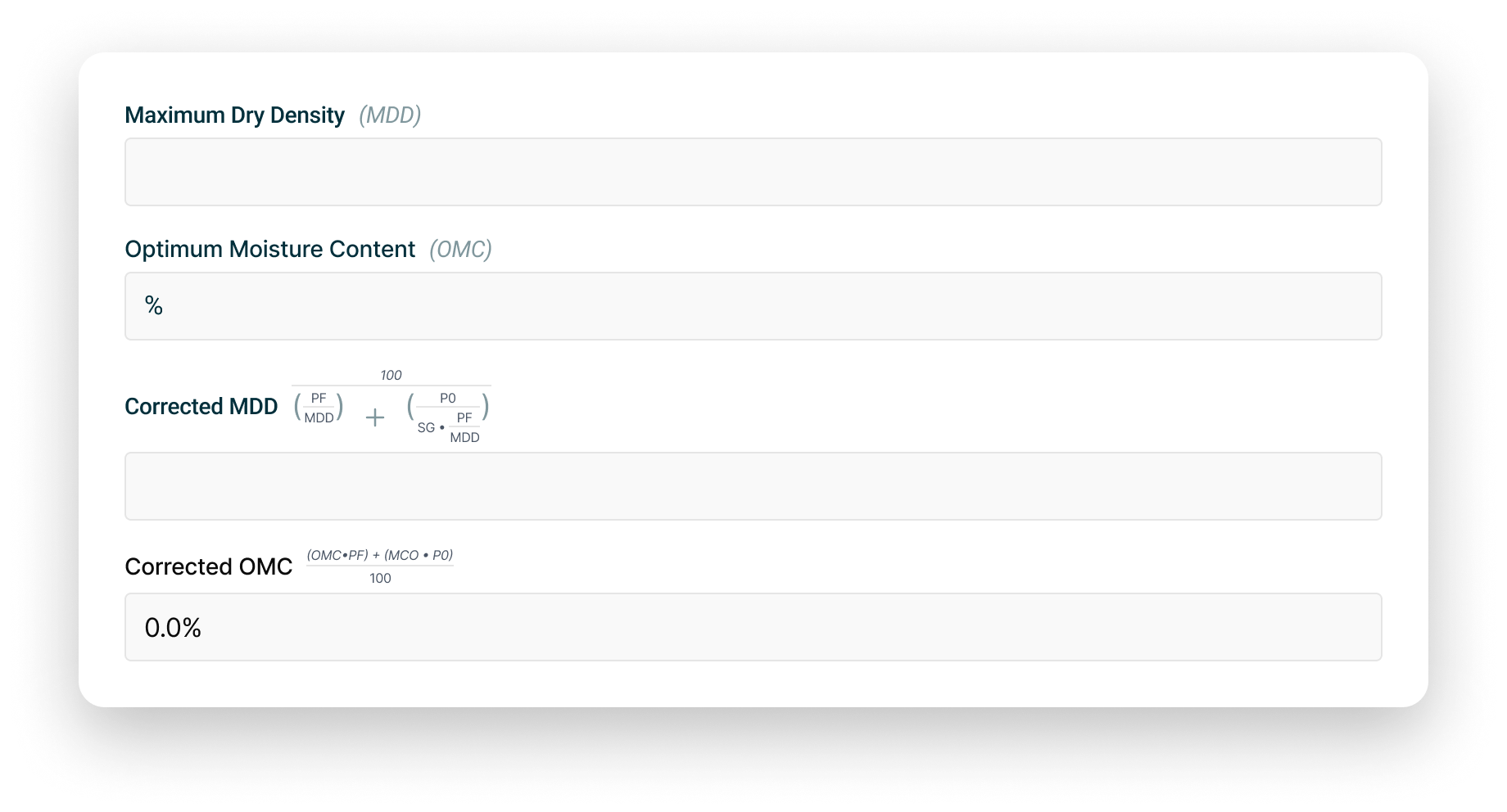
Automated calculations reduce manual errors in soil compaction testing by instantly calculating dry density, percent compaction, and comparing results against laboratory Proctor values such as maximum dry density (MDD) and optimum moisture content (OMC).
Integrated Proctor Data
Lab Proctor results can be stored centrally and referenced during field testing.
Field technicians can immediately see:
- Required compaction percentage
- Maximum dry density
- Optimum moisture
Ensuring faster decision making onsite.
.png?width=1882&height=832&name=Group%2027445%20(1).png)
Proctor test curves plot moisture content versus dry unit weight to determine the maximum dry density and optimum moisture content of soil. These laboratory values are used as the reference standard for evaluating field compaction tests.
Review and Approval Workflows
Project managers and lab managers can:
- Review tests digitally
- Approve or reject results
- Track revisions
- Maintain a full audit trail
This dramatically improves defensibility during DOT audits or disputes.
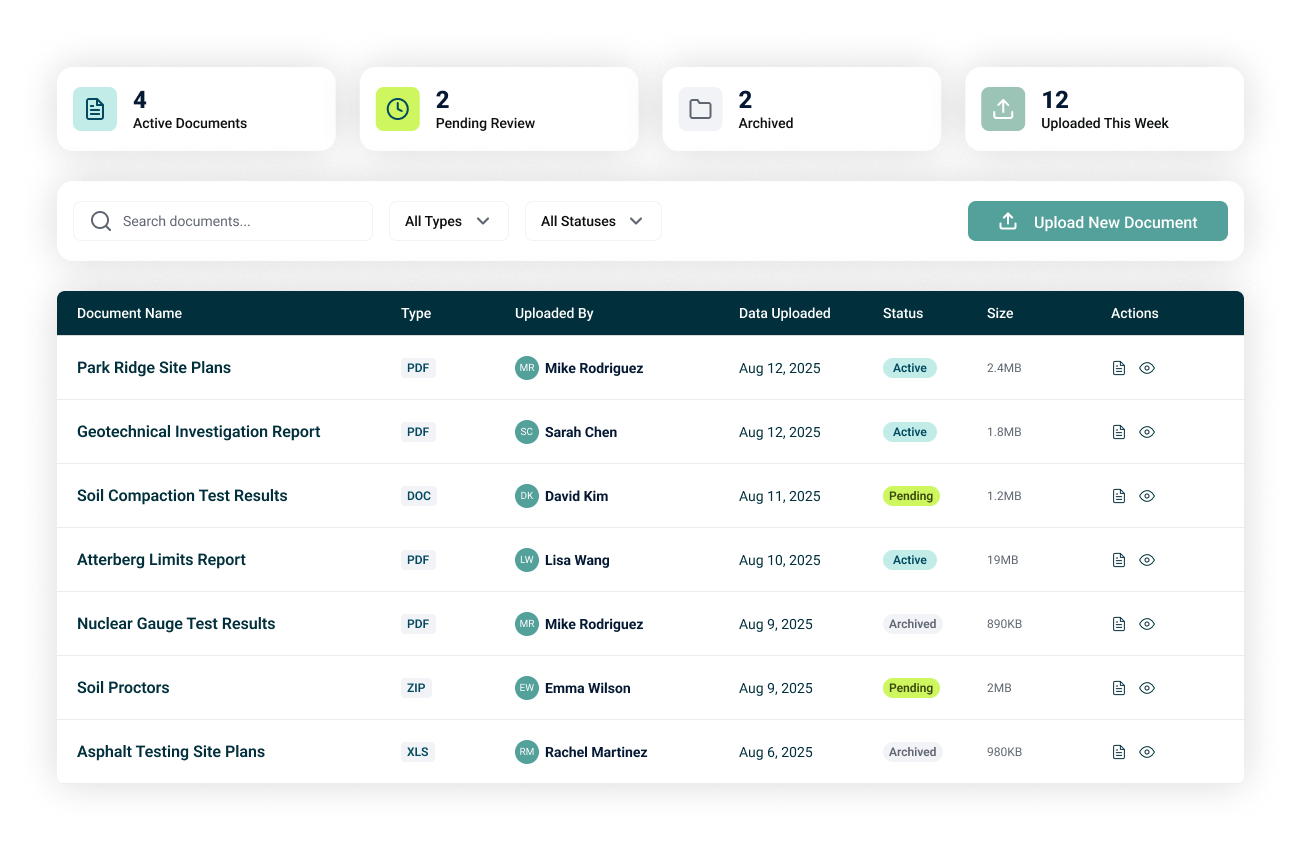
Digital review and approval workflows allow project managers and lab managers to verify soil compaction test results, track revisions, and maintain a complete audit trail for quality assurance and DOT compliance.
Faster Turnaround and Better Client Reporting
With Aldoa:
- Data flows directly into standardized reports
- Reports are consistent across projects
- No retyping
- Faster client delivery
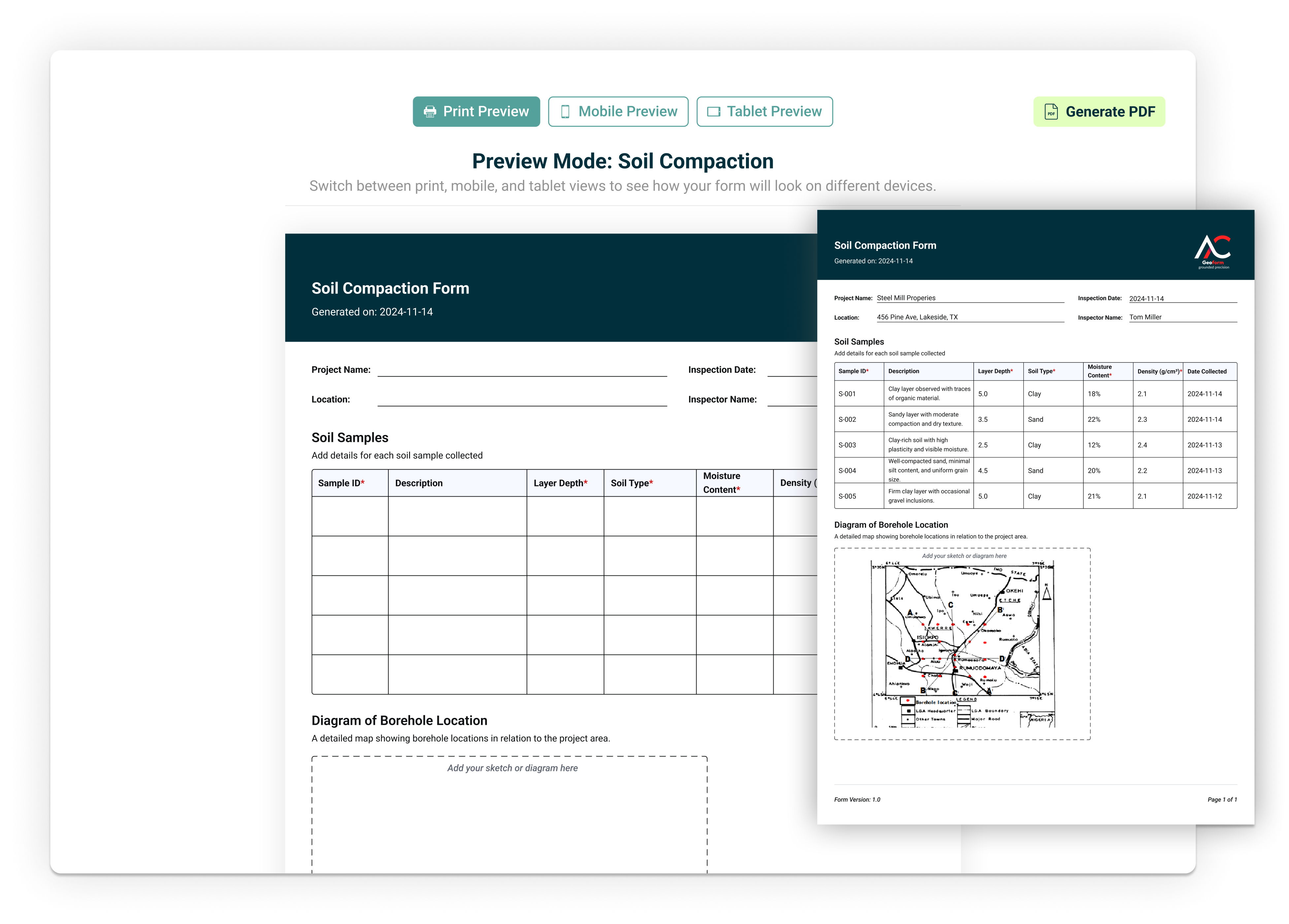
Automated reporting converts field soil compaction test data into standardized client reports, improving turnaround time while ensuring consistent geotechnical documentation across projects.
Firms reduce turnaround time and improve perceived professionalism.
Why Digital Density Testing Workflows Matter in 2026
Construction timelines are tightening.
Clients expect faster reporting.
Margins are under pressure.
Firms that digitize density and compaction workflows benefit from:
- Higher technician efficiency
- Reduced admin hours
- Improved data accuracy
- Easier training
- Better scalability
Paper systems cannot compete with real-time digital visibility.
Frequently Asked Questions About Soil Density and Compaction Testing
What is the difference between soil density and compaction testing?
Density testing measures in-place density. Compaction testing determines how soil is compacted and compares field results to lab maximum density values.
What ASTM standard governs nuclear gauge testing?
ASTM D6938.
What is the difference between Standard and Modified Proctor?
ASTM D698 uses lower compaction energy. ASTM D1557 uses higher compaction energy and is typical for heavy infrastructure.
What percent compaction is typically required?
Most projects require 95 percent or 98 percent of maximum dry density.
The Future of Soil Density and Compaction Testing
The testing methods defined by ASTM will remain consistent.
What is changing is how data is captured, calculated, reviewed, and reported.
Modern geotechnical and CMT firms are moving toward:
- Mobile field forms
- Automated calculations
- Integrated lab and field systems
- Real-time QA review
- Single source of truth data platforms
Aldoa was built specifically to support this shift.
Final Thoughts
Soil density and compaction testing are foundational to construction quality control.
From ASTM D6938 nuclear gauge testing to Proctor compaction standards under ASTM D698 and D1557, the procedures are well defined.
The opportunity today is not changing the test methods. It is modernizing how the work is managed.
For geotechnical and construction materials testing firms looking to improve turnaround time, reduce errors, and scale efficiently, digital field and lab data management is no longer optional.
Aldoa is a modern field and lab data management platform for CMT and geotechnical teams. With mobile forms for field technicians, review and calculations for project managers and lab staff, and a true single source of truth, Aldoa helps firms deliver quicker turnaround and better data quality.
Learn more and schedule a demo at www.aldoa.com.
.svg "Aldoa Assets (3)")