Sieve analysis is one of the most fundamental laboratory tests in civil engineering, construction materials testing, and geotechnical engineering. It determines the particle size distribution of aggregates or soils and forms the foundation for concrete mix design, asphalt performance, drainage evaluation, and compaction quality control.
Despite its simplicity, sieve analysis remains one of the most frequently performed and most manually calculated tests in CMT laboratories.
This guide explains:
- What sieve analysis is
- The step-by-step procedure
- How calculations work
- ASTM standards that apply
- How results are interpreted
- Common errors
- How digital workflows modernize the process
If you are specifically looking for the aggregate standard, see our in-depth guide to ASTM C136 Sieve Analysis Explained.
What Is Sieve Analysis?
.png?width=2400&height=1176&name=ASTM%20C136%20%E2%80%93%20Sieve%20Analysis%20(1).png)
Sieve analysis, also called a gradation test or grain size distribution test, is a laboratory procedure used to determine the distribution of particle sizes within a sample of aggregate or soil.
The test works by passing a dried sample through a stack of sieves with progressively smaller openings. Each sieve retains particles larger than its opening size. By weighing the material retained on each sieve, technicians calculate the percentage of material in each size range.
In simple terms, sieve analysis answers this question:
How much of this material is coarse gravel, medium aggregate, sand, or fines?
Why Sieve Analysis Matters
Particle size distribution directly affects material performance.
-
In concrete, improper gradation can increase void content and reduce strength.
-
In asphalt, excess fines can reduce stability.
-
In base materials, poor gradation affects compaction and drainage.
-
In soils, gradation determines permeability and classification.
Without sieve analysis, engineers cannot confidently design mixes or validate material quality.
What Is the Principle of Sieve Analysis?
The principle of sieve analysis is mechanical separation by particle size.
Particles larger than a sieve opening are retained.
Particles smaller than the opening pass through to the next sieve.
By stacking sieves from largest opening to smallest, the material is sorted into size fractions. The mass retained on each sieve represents the proportion of particles within that size range.
The test assumes:
- The sample is representative
- The sample is fully dried
- Sieving duration is sufficient for separation
- No material is lost during transfer
Types of Sieve Analysis
Sieve analysis varies depending on material type and applicable standards.
1. Aggregate Sieve Analysis
Used for coarse and fine aggregates in concrete and asphalt.
Primary standard:
2. Soil Sieve Analysis
Used for granular soils and geotechnical classification.
Primary standards:
- ASTM D6913
- ASTM D422 (historical reference)
3. Wet Sieve Analysis
Used when fine particles adhere to coarse aggregate and require washing.
Often paired with:
- ASTM C117 (Materials Finer Than No. 200 Sieve)
Sieve Analysis Equipment
Standard equipment includes:
- Balance accurate to 0.1 g or 0.1% of sample mass
- Standard ASTM sieves
- Mechanical sieve shaker
- Drying oven (110 ± 5°C)
- Pan and cover
- Brushes for cleaning
Common sieve sizes include:
Coarse Aggregate
5 in., 3½ in., 2 in., 1 in., ¾ in., ½ in., ⅜ in.
Fine Aggregate
No. 4, No. 8, No. 16, No. 30, No. 50, No. 100, No. 200
Sieve Analysis Procedure (Step-by-Step)
Below is the standard dry sieve analysis workflow used in most CMT laboratories.
Step 1: Sample Preparation
Dry the sample to constant mass at 110 ± 5°C.
Allow it to cool.
Record total dry mass (Mₜ).
Moisture in the sample will distort results and inflate retained weights.
Step 2: Stack the Sieves
Arrange sieves from largest opening at the top to smallest at the bottom.
Place a collection pan underneath.
Secure a lid on top.
Double-check order before testing.
Step 3: Add Sample and Shake
Place the dried sample on the top sieve.
Secure the stack in a mechanical shaker and shake for 5 to 10 minutes, depending on material type and specification requirements.
The goal is complete particle separation without overloading individual sieves.
Step 4: Weigh Material Retained
Remove each sieve carefully.
Weigh and record the mass retained on each sieve (Mᵢ).
Ensure no material is lost during transfer.
Calculations include:
Percent Retained
(Mᵢ / Mₜ) × 100
Cumulative Percent Retained
Sum of all percentages retained on that sieve and above.
Percent Passing
100 – cumulative percent retained
Example:
| Sieve |
Weight Retained (g) |
% Retained |
Cum. % Retained |
% Passing |
| ¾ in. |
50 |
5 |
5 |
95 |
| ½ in. |
120 |
12 |
17 |
83 |
| ⅜ in. |
180 |
18 |
35 |
65 |
| No. 4 |
220 |
22 |
57 |
43 |
| No. 8 |
260 |
26 |
83 |
17 |
| Pan |
170 |
17 |
100 |
0 |
Step 6: Plot Gradation Curve
Plot percent passing versus sieve size on semi-log graph paper.
The curve reveals:
- Well-graded material
- Gap-graded material
- Uniformly graded material
How Accurate Is Sieve Analysis?
Sieve analysis is highly reliable when performed correctly, but accuracy depends on:
- Proper drying
- Representative sampling
- Calibrated balance
- Correct shaking time
- Clean, undamaged sieves
Small procedural errors can compound into major reporting inaccuracies.
How to Interpret Sieve Analysis Results
A smooth curve indicates well-graded material with good particle distribution.
A steep curve suggests uniform grading, which may cause segregation.
Excess fines may impact permeability and compaction.
For aggregates, results are compared to specification limits such as ASTM C33 or state DOT requirements.
Common Sieve Analysis Errors
Incomplete drying, overloading sieves, incorrect stacking order, insufficient shaking, loss of fines during transfer, and damaged sieve mesh.
Routine calibration and quality checks reduce these risks.
ASTM Standards for Sieve Analysis
Depending on material type, different ASTM standards apply.
ASTM C136: Aggregate sieve analysis for concrete and asphalt materials.
ASTM C117: Determines materials finer than the No. 200 sieve by washing.
ASTM D6913: Sieve analysis for soils in geotechnical engineering.
If you are testing aggregate for concrete or asphalt, read our detailed breakdown of ASTM C136 Sieve Analysis Explained for equipment requirements, calculations, and reporting guidance.
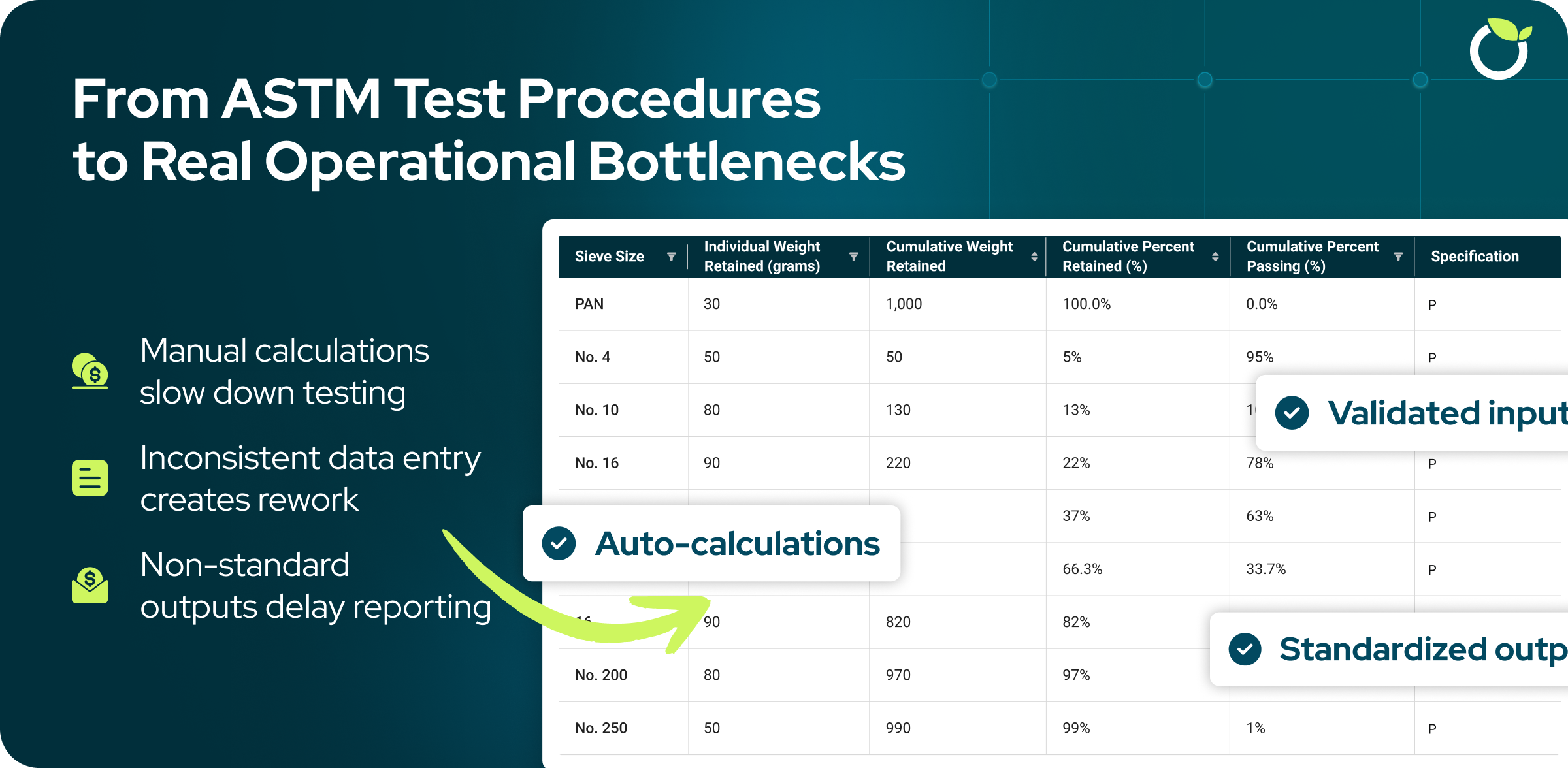
Manual Sieve Analysis vs Digital Workflow
Traditional workflows involve:
- Handwritten data sheets
- Manual calculator use
- Excel spreadsheets
- Manual report formatting
This process increases the risk of:
- Transposed numbers
- Formula errors
- Missing entries
- Delayed report turnaround
Digital lab platforms automate:
- Percent retained calculations
- Cumulative totals
- Validation checks
- Report formatting
- Data storage
.png?width=2400&height=1176&name=Traditional%20ASTM%20Workflow%20vs%20Aldoa%20Workflow%20(Highest%20Priority).png)
How Aldoa Modernizes Sieve Analysis Reporting
Aldoa provides standardized digital forms for sieve analysis testing used by CMT and geotechnical labs.
Technicians enter retained weights directly into a pre-built form.
Percent retained, cumulative values, and percent passing are calculated automatically.
Reports are generated instantly in ASTM-compliant format.
Benefits include:
- Reduced reporting time
- Eliminated spreadsheet errors
- Real-time lab and office visibility
- Centralized data storage
- Easier audit traceability

Labs can also link sieve analysis results with other tests such as specific gravity and absorption for full material traceability.
Frequently Asked Questions About Sieve Analysis
What is sieve analysis used for?
Sieve analysis determines the particle size distribution of aggregates or soils used in construction projects.
Percent Retained = (Weight Retained / Total Sample Weight) × 100
Percent Passing = 100 − Cumulative Percent Retained
What does a No. 200 sieve mean?
The No. 200 sieve has openings of 0.075 mm and is used to measure fine particles such as silt and dust.
What is the difference between ASTM C136 and ASTM D6913?
ASTM C136 applies to aggregates used in concrete and asphalt.
ASTM D6913 applies to soils in geotechnical testing.
How long does sieve analysis take?
Testing typically takes 30 to 60 minutes, depending on drying time and reporting method.
Sieve Analysis in CMT vs Geotechnical Labs
CMT laboratories focus primarily on aggregate gradation for concrete and asphalt production.
Geotechnical labs use sieve analysis to classify soils and evaluate drainage properties.
While procedures are similar, reporting formats and specification comparisons differ.
The Future of Sieve Analysis in Construction Labs
The physical testing method has not changed significantly in decades. What has changed is how results are calculated, stored, and reported.
Labs moving away from spreadsheets toward centralized digital systems see:
- Faster client turnaround
- Fewer reporting errors
- Easier multi-project management
- Improved audit readiness
Modernization does not replace ASTM standards. It enhances consistency and compliance.
Conclusion
Sieve analysis remains one of the most essential tests in civil engineering and construction materials testing. Accurate particle size distribution data ensures reliable concrete, stable asphalt, and properly compacted base materials.
While the mechanical procedure remains simple, manual reporting methods introduce unnecessary risk and inefficiency.
Digital lab platforms streamline calculations, eliminate errors, and standardize reporting without changing the ASTM testing method itself.
For aggregate-specific guidance, including step-by-step ASTM requirements, see our complete guide to ASTM C136 Sieve Analysis Explained.
If your lab is ready to modernize sieve analysis workflows, learn more and schedule a demo at www.aldoa.com.
.svg "Aldoa Assets (3)")