Special inspections play a critical role in ensuring construction projects meet building code requirements and structural safety standards. But the inspection itself is only part of the process.
The results of every inspection must be formally documented in a special inspection report.
These reports provide the official record that construction activities were inspected and verified according to approved plans, engineering specifications, and building code requirements.
In this guide, we will explain:
- What a special inspection report is
- When inspection reports are required
- What information every report must include
- A real example of a special inspection report
- How field inspectors collect inspection data
- How digital tools streamline inspection documentation
What Is a Special Inspection Report?
A special inspection report is the formal documentation produced by a qualified inspector after performing a required construction inspection.
The report verifies whether the inspected work complies with:
- approved construction documents
- structural engineering specifications
- building code requirements
- project-specific inspection programs
These reports are often required by local building departments before construction can continue to the next phase.
Special inspection reports provide an essential record for:
- engineers of record
- building officials
- project owners
- contractors
They confirm that the inspected construction work meets safety and structural performance requirements.
Special inspection reports provide documented proof that construction work was inspected and complies with approved engineering plans and building codes.
When Special Inspection Reports Are Required
Special inspection reports are typically required whenever inspections mandated by the International Building Code (IBC) are performed.
These inspections occur during critical construction stages such as:
- foundation preparation
- structural steel installation
- concrete placement
- masonry construction
- fireproofing installation
- post-installed anchor installation
Each inspection must be documented to confirm the inspected work meets project specifications.
The final project closeout often includes a summary of all special inspection reports performed during construction.
If you want to understand when these inspections are required, read our complete guide to special inspections in construction.
Key Sections of a Special Inspection Report
Although report formats vary between engineering firms and jurisdictions, most special inspection reports include similar core sections.
This section identifies the project and inspection context.
Typical information includes:
- project name
- project number
- client or contractor
- site address
- permit number
- inspection date
This ensures the inspection record can be tied to the correct construction project.
Inspection Scope
The report describes the work that was inspected.
For example:
- footing bearing capacity verification
- structural steel welding inspection
- concrete placement observation
- soil compaction testing
The inspection scope confirms exactly what construction activity was evaluated.
Many special inspections include testing activities.
Examples include:
- Dynamic Cone Penetrometer (DCP) testing
- concrete slump testing
- concrete cylinder strength testing
- bolt torque verification
- weld inspection
These tests help confirm that materials and installations meet engineering requirements.
Inspection Results
Inspectors document their observations during the inspection.
This section often includes:
- soil conditions
- reinforcement placement
- structural connections
- concrete placement conditions
- installation procedures
If the inspected work meets requirements, the inspector documents compliance.
Items Requiring Correction
If deficiencies are discovered, they are documented in the report.
Examples include:
- insufficient soil bearing capacity
- incorrect anchor installation
- improper reinforcement placement
- incomplete welding
Contractors must correct these issues before construction proceeds.
Inspector Certification
The report concludes with the inspector's certification that the inspection was performed according to applicable codes and standards.
This section typically includes:
- inspector name
- certification or license number
- engineering firm name
- reviewer approval
This certification gives the report legal and regulatory authority.
Example Special Inspection Report
Below is an example of a typical special inspection report used on a construction project.
.png?width=1908&height=2563&name=Container%20(1).png)
Example of a special inspection report documenting project details, inspection results, testing performed, and corrective actions.
This report example includes several key components:
- site and project identification
- inspection scope and description
- testing performed
- inspection observations
- corrective action notes
- inspector certification
This format allows engineers and building officials to quickly review inspection results and determine whether construction can proceed.
A clear and structured inspection report allows engineers and building officials to quickly verify construction compliance.
How Inspectors Collect Field Inspection Data
Traditionally, inspectors documented field observations using handwritten notes, printed forms, and later transferred the information into report templates.
This manual workflow creates several problems.
Field data may be scattered across:
- paper notebooks
- spreadsheets
- photo folders
- test equipment reports
When inspectors return to the office, they must manually compile all of this information into a formal inspection report.
This process can take hours and increases the risk of missing information.
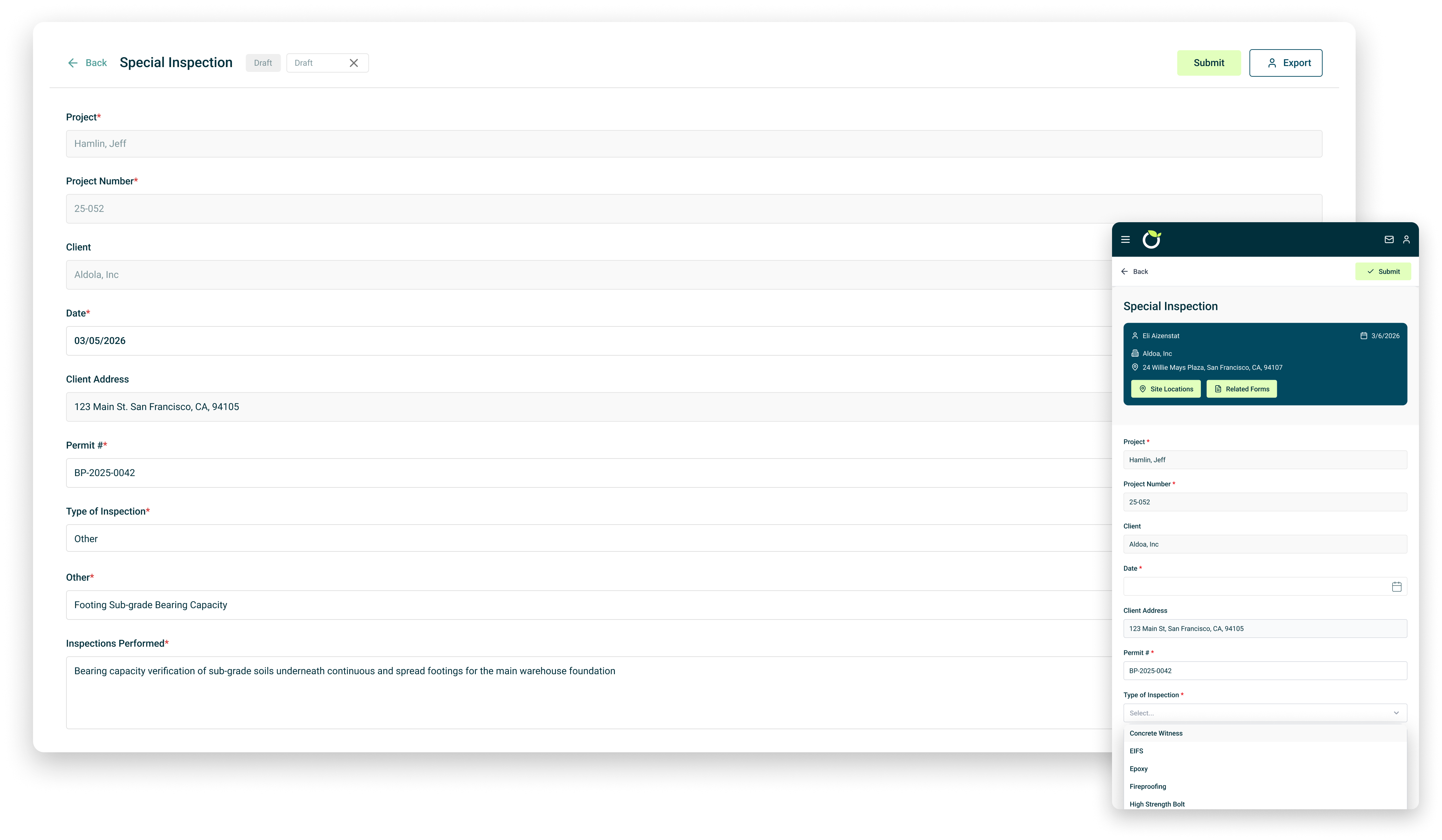
Digital inspection forms allow inspectors to capture project information, inspection observations, and test results directly in the field.
Challenges With Traditional Special Inspection Reporting
Many engineering firms still rely on manual reporting processes. These workflows often result in:
Delayed reporting: Inspection reports may not be delivered until hours or days after the inspection.
Data entry errors: Information copied from field notes into reports can introduce mistakes.
Disconnected documentation: Photos, test data, and observations may be stored in separate systems.
Slow project approvals: Engineers and building officials must wait for final reports before approving construction progress.
As inspection volumes increase, these manual processes become difficult to manage efficiently.
Modern inspection platforms are transforming how special inspection reports are created.
Instead of assembling reports manually, inspectors can collect inspection data directly in digital forms during the inspection.
Digital inspection systems allow teams to:
- create standardized inspection templates
- capture photos and test data in real time
- perform automatic calculations
- instantly generate professional inspection reports
- share documentation with engineers and clients
By capturing inspection data once and automating report creation, firms can significantly reduce administrative work.
Digital inspection platforms allow inspectors to capture field data once and automatically generate professional inspection reports.
The Future of Inspection Documentation
As construction documentation requirements continue to grow, inspection reporting processes must evolve as well.
Engineering and testing firms are increasingly adopting digital inspection platforms to improve reporting accuracy and efficiency.
These systems allow inspectors to focus more on the inspection itself while reducing time spent compiling documentation.
For firms performing hundreds or thousands of inspections each year, digital reporting workflows can dramatically streamline operations.
If you want to see how the full process works, read our guide to the complete special inspection workflow from field observation to final report.
Conclusion
Special inspection reports provide the official record that construction work was inspected and verified according to engineering plans and building code requirements.
These reports are essential for maintaining construction quality, ensuring regulatory compliance, and protecting long-term structural safety.
While traditional inspection reporting workflows often rely on manual documentation, modern digital inspection platforms are making it easier for engineering teams to capture field data and generate professional reports faster.
As construction projects become more complex, efficient inspection documentation will continue to play a critical role in successful project delivery.
.svg "Aldoa Assets (3)")