The engineering shift is real, and it is accelerating
The engineering and consulting industry is in the middle of a major operational reset. Labor shortages are tightening across geotechnical, construction materials testing (CMT), and environmental firms. At the same time, client expectations are rising. Faster turnaround, clearer documentation, and fewer errors are now the baseline, not a bonus.
This is exactly why Vertical AI for engineering and AI-powered report writing are taking off. Not as flashy add ons, but as practical tools that remove the most painful parts of delivery. The result is more projects completed with the same headcount, fewer late nights, and better data quality from field to final report.
In this expanded guide, we will break down what Vertical AI is, why it matters specifically for engineers, and how Aldoa AI features like voice dictation, real-time field validation, and automatic report population are already changing day to day workflows.
The Labor Crunch: Why Engineering Needs AI
Engineering firms have always been talent driven businesses. But right now, hiring is tougher and retaining experienced staff is even tougher. Key roles such as field technicians, project managers, and geotechnical engineers are hard to fill, and even harder to scale.
The hidden problem is that labor shortages are colliding with admin overload. Engineers are spending a shocking portion of their week re typing field notes, cleaning spreadsheets, and hand assembling reports. That is non billable time in a labor constrained market, which is basically the worst of both worlds.
AI helps by shifting repetitive work away from scarce humans. But only if the AI is built for the realities of engineering. General tools can write a decent email or summarize meeting notes, but they do not understand SPT blow counts, Proctor curves, ASTM tables, or the structure of a Phase 1 ESA. If you have ever tried asking a generic chatbot to draft a geotechnical report, you know the output is often vague, inconsistent, and missing crucial context.
That gap is why Vertical AI exists.
What Is Vertical AI, and Why Does It Matter for Engineers?
Vertical AI refers to artificial intelligence trained on highly specialized industry data. Horizontal AI tries to be good enough for everyone. Vertical AI tries to be excellent for a specific field.
For engineering, that difference is huge. Engineering deliverables are not just text. They are structured documents built on standards, calculations, and repeatable formats. A good AI system needs to know:
- the language engineers use
- the way data is collected in the field and lab
- the standards that govern outputs (ASTM, AASHTO, state DOT specs, and client templates)
- the typical structure of deliverables like boring logs, gradation reports, compaction summaries, and environmental assessments
Aldoa is building Vertical AI trained on thousands of environmental, geotechnical, and CMT reports, paired with structured field and lab data. That means Aldoa can generate reports that are not only fast, but aligned to real engineering workflows and compliance expectations.
Think of it like this: your best technician or engineer has a consistent way of recording observations and writing conclusions. Vertical AI standardizes that expertise and makes it scalable across every project and every team.
AI-Powered Report Writing: Reclaiming Time and Increasing Accuracy
Report writing is where engineering firms quietly bleed hours. The work is necessary, but a lot of it is mechanical.
Typical manual reporting looks like:
- tech collects notes in the field
- notes get re entered into spreadsheets or Word
- PM or engineer checks for gaps and errors
- tables, figures, and logo pages get formatted
- the team chases missing info
- final PDF is assembled and sent
Each step adds delay and introduces risk. Even top teams make transcription mistakes when data is moved across tools.
AI-powered report writing flips the model. Instead of treating the report as something built after the work is done, the report becomes a live output of the data you collect.
With Aldoa, structured field and lab data automatically syncs into reporting templates, so the deliverable is essentially assembled as the project progresses.
What that unlocks
- Eliminate non billable admin hours: Most firms save hours per week per PM and tech simply by removing double entry.
- Reduce human error: When you stop re typing data, you stop creating new mistakes.
- Accelerate turnaround times: Reports that used to take hours can be produced in minutes because the “assembly” work has already happened.
- Empower junior staff: AI guided templates and automated population let newer team members produce consistent reports without needing years of tribal knowledge.
Aldoa AI Features That Make This Real Today
AI in engineering is only valuable if it works in the field, with gloves on, in a truck, and under real time deadlines. Here are Aldoa AI features on the Aldoa AI Solution Page, and how they map directly to daily pain points.
1. AI Voice Dictation and Speech to Text
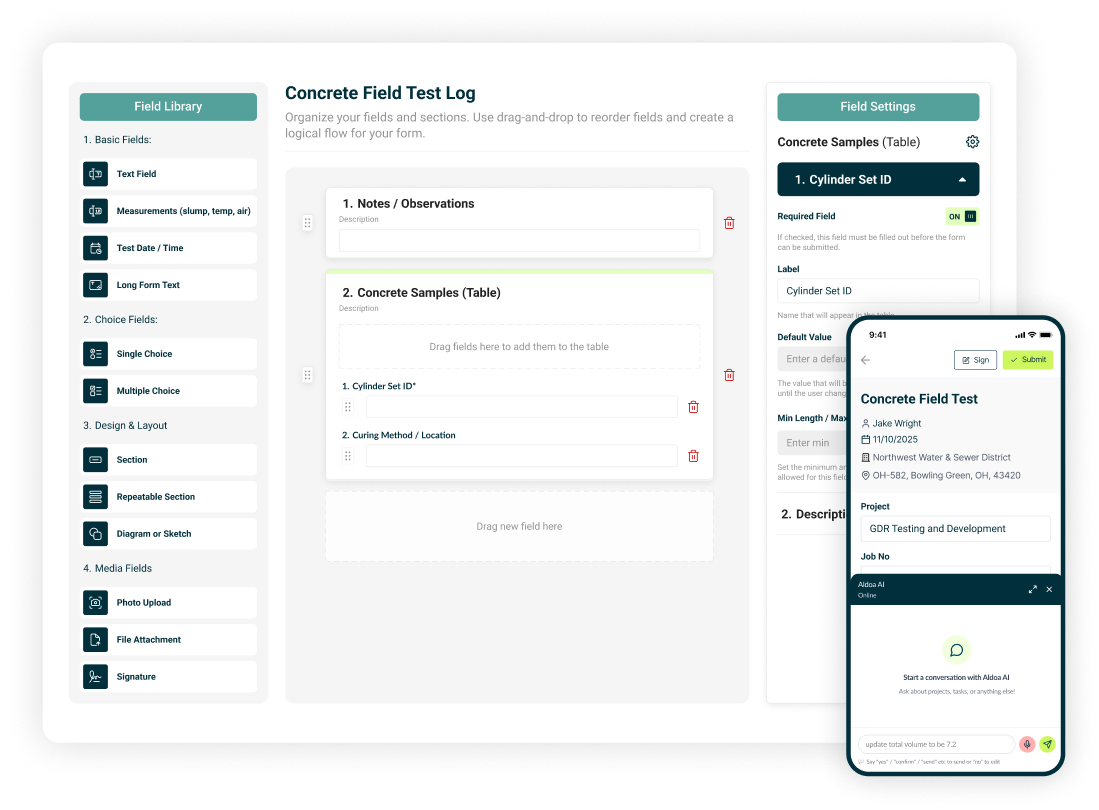
Field notes are often the bottleneck. Typing on site is slow, and paper notes create a second round of work later. Aldoa’s AI Voice Dictation lets technicians speak observations directly into mobile forms, converting speech into structured data on the spot.
Why it matters
- faster data capture in active field conditions
- fewer forgotten details because people record in the moment
- less time spent after the job trying to decode handwriting
2. Real Time Field Validation
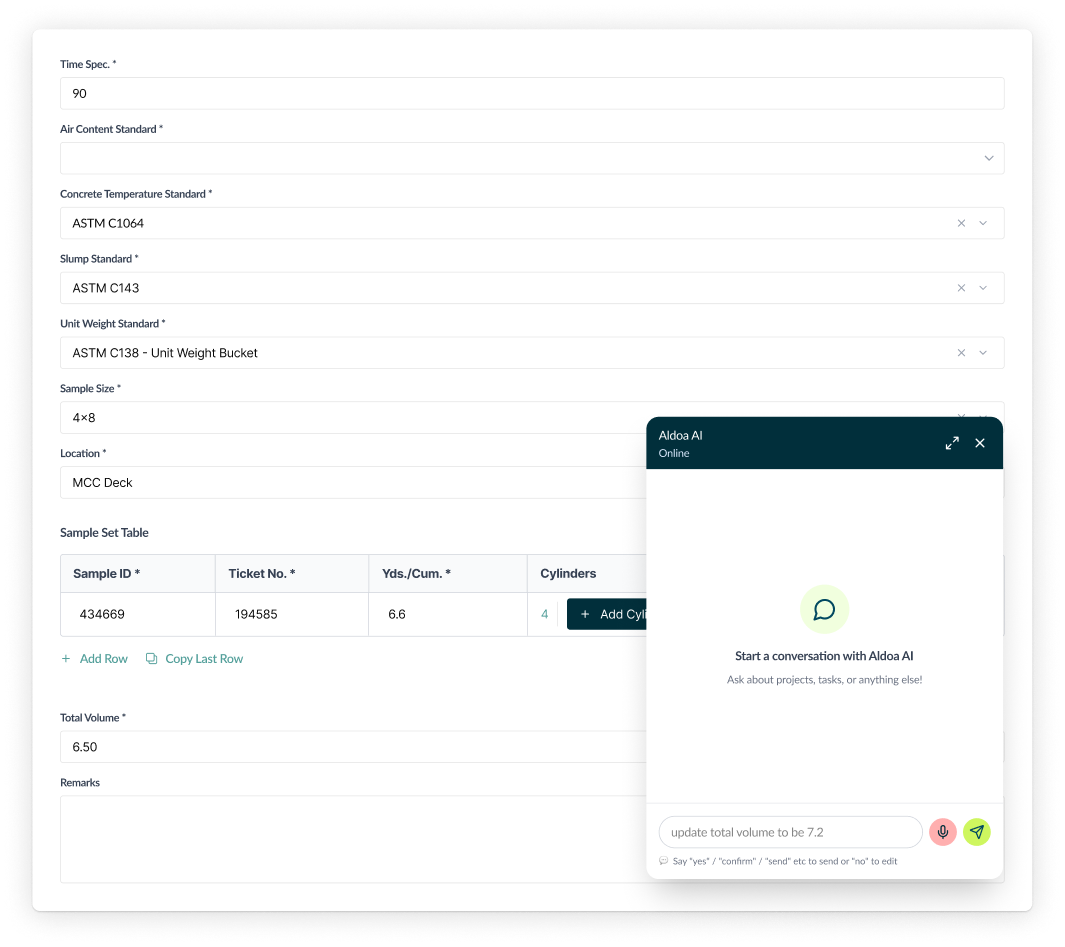
Bad data in means bad report out. Aldoa runs validation rules as data is collected, flagging missing fields, out of range values, and formatting issues before the tech leaves the site.
Why it matters
- prevents back and forth with techs after the fact
- reduces project delays caused by missing or unusable data
- ensures standardization across teams and offices
3. Automatic Report Population
.png?width=1736&height=1248&name=1%20(1).png)
Once data is validated, Aldoa automatically pushes it into technical report templates. Tables, calculated fields, and narrative sections populate instantly, so the report is always near draft ready without manual copy paste.
Why it matters
- eliminates re entry from field forms to Word
- makes reporting a byproduct of operations, not a separate task
- supports consistent ASTM and AASHTO style outputs
Together, these three features create a loop: voice capture makes data easy to record, validation makes it reliable, and auto population makes it deliverable.
Engineering Workflow Automation: Where AI Delivers Maximum ROI
AI becomes transformative when it connects workflows, not when it sits on top of them.
Modern engineering workflow automation combines:
- smart, structured field data collection
- centralized cloud data management
- built in calculations and lab integrations
- standardized report generation
- fast review and approval
Aldoa’s platform is designed around this full chain, connecting field, lab, PM, and reporting in one system.
The ROI story in simple terms
Engineering is a labor heavy industry. Labor is expensive, and it is the constraint on growth. Software is a small spend compared to payroll, but it can multiply payroll productivity.
Instead of hiring your way out of admin bottlenecks, automation lets you:
- complete more projects per month with the same team
- reduce overtime and burnout
- improve margins because fewer hours go to rework
- deliver a more consistent client experience
AI is not replacing engineers. It is removing the repetitive steps that keep engineers from engineering.
Consider this: the U.S. engineering services sector represents over $500 billion in annual spending, with labor costs comprising nearly 40% of that. Meanwhile, software spending is a fraction of that number. As AI tools mature, this gap is closing. AI isn’t replacing skilled engineers — it’s enabling them to focus on what they do best: solving complex problems and delivering quality work.
Why Geotechnical Report Automation Is a Game Changer
Geotechnical and CMT firms are perfect candidates for AI automation because much of the work is structured and repeatable, yet still requires expert oversight.
Examples include:
- boring logs and subsurface summaries
- SPT and CPT data reporting
- gradation and Atterberg limits
- Proctor and density test reports
- concrete, aggregate, and asphalt testing deliverables
These reports follow standard formats, repeatable calculations, and predictable tables. When the inputs are clean, AI can handle the assembly. That means engineers spend their time on interpretation, design implications, and recommendations, where their expertise matters most.
Aldoa makes this possible by tying validated data directly to report templates, so compliance and standardization improve automatically.
What the future looks like for Vertical AI in engineering
The next wave is not just faster reports. It is smarter decision support.
Vertical AI is heading toward:
- proactive quality checks that catch anomalies across projects
- instant comparisons to historical benchmarks
- automated draft conclusions based on patterns in data
- workflow recommendations that reduce risk and rework
The firms that win will be the ones who treat AI as core infrastructure, not a side experiment.
The Future Is Now: Get Started with Vertical AI
We believe the future of engineering is not just digital. It is intelligent.
Vertical AI and AI-powered report writing are already delivering measurable gains for geotechnical, CMT, and environmental firms. By combining structured data capture with AI voice dictation, real-time validation, and automatic report population, Aldoa helps teams move faster and with more confidence.
If you are curious how Vertical AI can fit into your operations, let’s talk. Whether you are dealing with environmental assessments, field testing, or construction oversight, Aldoa is building the tools engineering professionals actually need.
Aldoa is a modern field and lab data management platform for CMT and geotechnical teams. It offers mobile forms for field techs, review and calculations for PMs and lab techs, a single source of truth, and an easy rollout that is intuitive and flexible. Teams get quicker turnaround and better data quality. Learn more and schedule a demo at
Book a demo or learn more at www.aldoa.com
Key Takeaways
- Vertical AI enables industry specific automation that general AI tools cannot match.
- AI-powered report writing reduces admin time and increases consistency.
- Aldoa AI features like voice dictation, real-time field validation, and automatic report population make automation practical in real field conditions.
- Engineering workflow automation drives ROI by helping teams deliver more work with fewer errors.
- Geotechnical report automation is a leading real world use case showing immediate time savings and quality gains.
The time to embrace AI in engineering is now.
.svg "Aldoa Assets (3)")